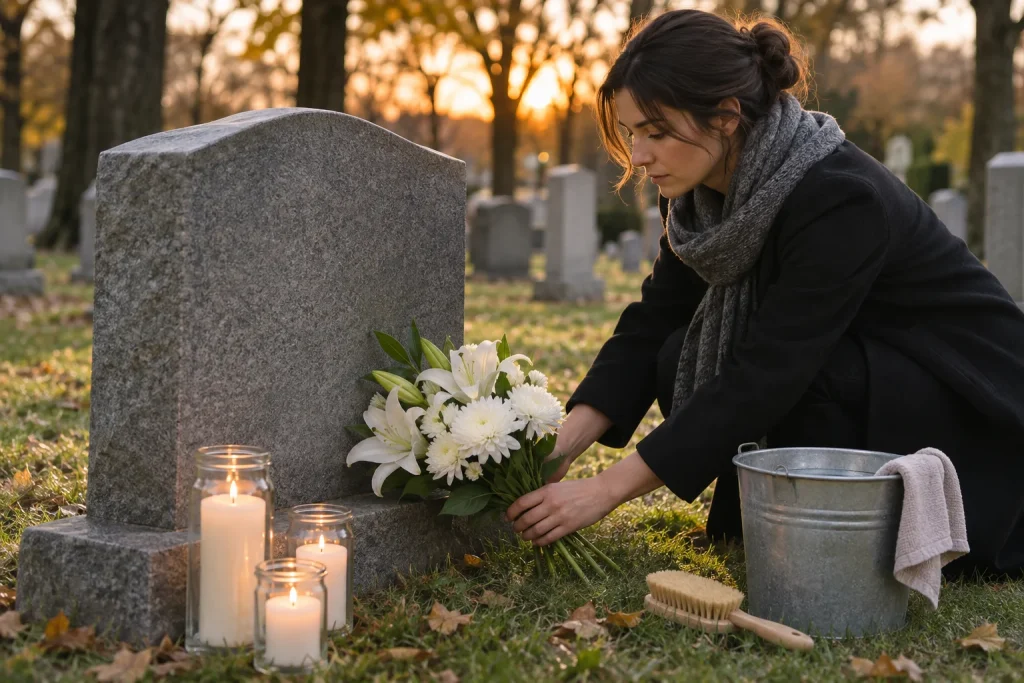
A cemetery monument-cleaning service should begin with authority, material and condition screening, not a promise to make a stone look new. Confirm who may authorize work, which cemetery and heritage requirements apply and whether the monument is suitable for the proposed service. Refer uncertain, unstable or deteriorating monuments to an appropriately qualified conservation specialist.
Establish permission before offering treatment
A relative’s request, access through an open gate and a photograph found online are not interchangeable evidence of authority. Ask the cemetery operator or landowner about the proposed work, the responsible monument contact and any required approvals. Check relevant local heritage or cemetery authorities before assuming ordinary business permission is sufficient.
Illinois’ official cemetery-preservation FAQ illustrates that preservation activities can involve government permits and training requirements in addition to landowner permission. That example does not establish the rules everywhere. Record the requirements for the actual cemetery and proposed activity, and obtain appropriate advice when authority is unclear.
Make screening a genuine decision gate
| Question | Reason to defer or refer |
|---|---|
| Is authorization documented? | Ownership, site approval or required permission is unresolved |
| Is the material understood? | Stone, coating, metal or previous treatment is uncertain |
| Is the structure stable? | Leaning, movement, cracks or loose pieces raise concern |
| Is the surface sound? | Flaking, powdering or other deterioration needs specialist assessment |
| What is the objective? | The request requires restoration, repair or an unrealistic appearance change |
Do not disturb the monument to answer a screening question. Ask the relevant authority what assessment activities are permitted before entry or work. A small test area is still treatment and needs appropriate permission, competence and a suitable method.
Use conservation guidance in its actual context
The National Park Service warns that cleaning can remove original material and that unstable or deteriorating surfaces warrant specialist consultation. VA guidance for government-furnished markers rejects a like-new objective and prohibits general-public power washing of those markers.
Those sources have specific contexts. Do not combine a pressure figure from one document with a chemical suggestion from another and market the mixture as a universally safe method. This article intentionally supplies no cleaning recipe. Operators need appropriate conservation training and the applicable material-, site- and authority-specific guidance.
Define a limited service output
The paid work may include an authorized site assessment, condition documentation and a separately approved treatment for a suitable monument. State which phases are included, what information the customer receives and what can cause the treatment phase to be declined.
Keep repair, resetting, excavation, inscription work and specialist stain or coating treatment separate. Do not offer a damaged monument a cosmetic cleaning package when its primary need is stabilization. A referral can be the correct outcome of screening, provided the customer understood the assessment arrangement.
Hypothetical example: a request for a bright-white finish
Imagine a family requests an illustrative service for an older marker and sends an image of a much newer white stone as the desired result. The cemetery’s permission process is completed, but authorized screening identifies an uncertain surface condition.
The operator explains that the requested appearance is not an appropriate promised outcome and pauses treatment for a conservation referral. They document the question without scraping, aggressively scrubbing or applying a product to demonstrate progress. The customer’s wish for a visible improvement does not establish material suitability.
If a specialist later approves a defined treatment and the necessary requirements are met, that becomes a separate decision with its own scope and evidence. The initial quote should not imply that every assessment leads to cleaning.
Document condition respectfully
Use photographs only where permitted and necessary for the work. Record the monument reference, observable condition, authorized scope and relevant restrictions. Treat names, family messages and other memorial details respectfully; do not turn them into promotional material without appropriate permission.
Keep before-and-after images comparable when they are legitimately created. Differences in lighting, wetness or angle can exaggerate appearance changes. Do not use another monument’s results as proof of what this one will look like or claim conservation success from a more dramatic photograph.
Plan time, supplies and closure conservatively
Account for permissions, travel, screening, approved treatment, documentation and any necessary return visit. Site access and environmental conditions can affect whether work proceeds. Avoid booking a volume route that pressures staff to continue when a monument needs referral.
At completion, describe what was actually done and what remains unresolved. Explain any approved follow-up without promising that biological growth, weathering or staining will never return. Recurring visits should be based on appropriate conservation guidance, not a sales assumption that more frequent cleaning is always better.
Service acceptance checklist
- Authority and site-specific requirements are resolved.
- Material and condition are within demonstrated competence.
- Referral triggers are practical and respected.
- The scope prioritizes original material and discloses possible material loss; no damage-free outcome is guaranteed.
- No universal pressure, chemical or appearance guarantee is offered.
- Documentation and promotional permissions are distinct.
- The customer can understand a decision not to treat.