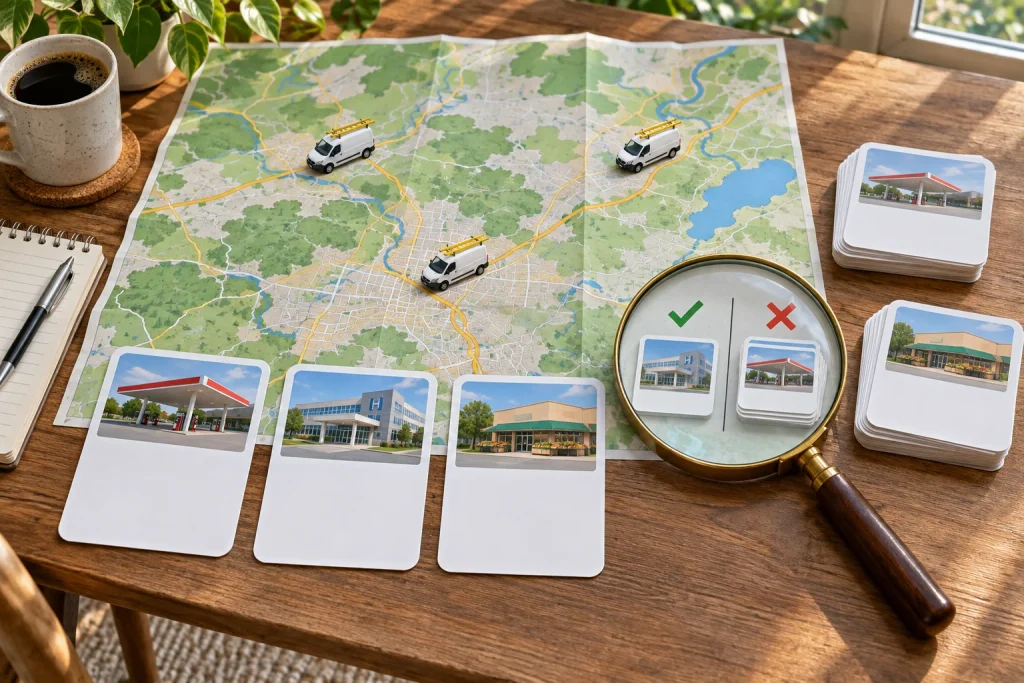
Create a service-area page only when the place changes what a prospective customer needs to know. A page can earn its place when it explains a real coverage boundary, an arrival constraint, a locally different service process, or a useful way to contact the business. Replacing one town name with another across dozens of otherwise identical pages does not help a visitor decide whether to inquire.
The useful question is not “Can we create a page for every nearby place?” It is “What would a customer in this place learn here that is not already clear elsewhere?” Google’s spam policies address doorway abuse, including pages created principally to rank for similar queries and funnel visitors to one destination. That is a reason to prefer concise, maintained information over location-name multiplication.
Start with the coverage fact
Write the operating fact before planning the page. Is the business available throughout a county, within a defined radius, only in named municipalities, or only after a travel-fee conversation? Does availability depend on a crew, appointment type, property access, or local regulation? Do not promise a response time, fee, or availability level that the business has not confirmed.
| Customer question | Best home for the answer | Why |
|---|---|---|
| “Do you serve the whole metro area?” | A clear service-area section on the contact or service page | The same answer applies across locations. |
| “Can your team reach my island or gated community?” | A dedicated page or detailed FAQ entry | Arrival, access or booking steps may be materially different. |
| “Which permit or disposal rule applies here?” | A page only after official local facts are verified and assigned an owner | Changing facts need a review process. |
| “Do you have an office here?” | Contact page with the actual address | Do not imply a location the business does not operate from. |
Use the mention test
A place normally needs only a mention when the service, process, contact method and expectations are unchanged. Put the named places in readable prose rather than a keyword list: “We schedule recurring garden maintenance across North County and the adjacent coastal communities; ask about properties beyond that area.” Pair it with the service boundary and a contact action. A customer can understand it without opening five nearly identical pages.
A dedicated page becomes defensible when it contains several location-specific elements. Examples include practical parking or building-access guidance, a distinctly different service scope, an official local resource, a named pickup or meeting point, a location-specific appointment process, or examples of the questions that local customers actually need answered. Do not invent testimonials, neighborhood projects, local partnerships, or office locations to make the page feel specific.
Build one useful location page
- State the real coverage relationship in the first paragraph: service area, office, dispatch point, or pickup area.
- Answer the local question that prompted the page. Keep the answer operational, not promotional.
- Link to the relevant core service page rather than duplicating its full sales copy.
- Include only verified arrival, parking, access, collection or scheduling information.
- Name an owner and a review date for changing facts such as hours, seasonal access, or municipal links.
- Give visitors a contact route when their address or request falls outside the described boundary.
Illustrative worked example
Imagine a mobile bike-repair business that serves a city and several suburbs. Its normal service page explains repairs and booking. A short service-area section lists the city and suburbs because the same mobile process applies. One island community, however, requires customers to meet at a ferry-side lot and appointments must account for crossing times. That community has a separate page because it can explain a genuinely different arrival process, where to meet, and what a customer should include in a request. The page does not claim a shop on the island or repeat generic repair copy.
Review the page as a visitor would
Ask a staff member who did not write it to answer four questions using only the page: Does the business serve this address? Is there a physical office here? What is different about booking or arrival? What should the visitor do if the request is outside the boundary? If the answers are vague, the page is probably a location label rather than a useful page.
Also audit internal links. A location page should lead back to the appropriate service and contact pages. It should not create a maze of town pages that all point to each other but offer no additional help.