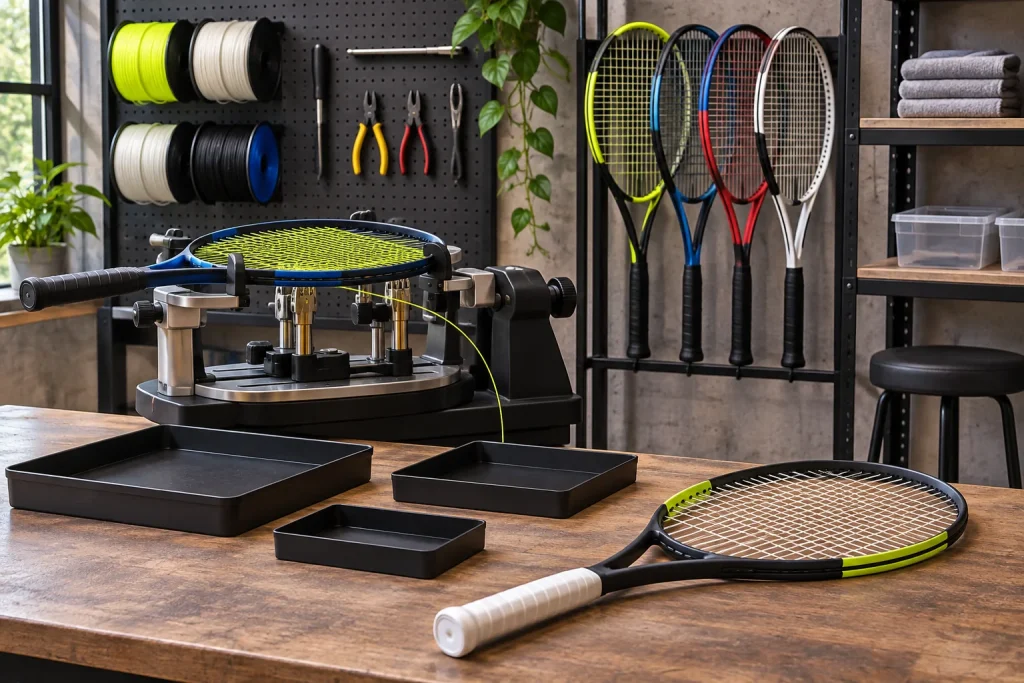
A sports equipment restringing service should accept a defined racket and a confirmed job specification before promising its place in the work queue. Record the sport, make, model, condition concerns, requested string setup and return arrangement. “The same as last time” is useful context, but it should point to a verified prior record rather than somebody’s memory.
Start with the equipment and jobs you are trained and equipped to handle. Tennis, squash and badminton are not interchangeable work categories simply because they use rackets. This is an intake and business-workflow guide, not a stringing technique manual, tension prescription or claim of professional certification.
Give each racket its own job record
A customer bringing two similar rackets creates two items of work, even when both share an invoice. Assign an item identifier to each and record distinguishing features. With permission, photograph the received condition and note accessories such as a cover. Keep the item identifier connected to its work record through assessment, string selection, completion and return.
Ask the customer to describe the requested result and any known damage or previous work. If the frame, grommets or other visible components raise a concern, put the job on assessment hold. Do not diagnose every defect at a busy collection counter or promise that new strings will resolve a structural or playing problem.
Record who may approve changes. A teammate dropping off several rackets may be authorized to deliver them but not to choose a different setup for every owner. Establish the decision contact for each order and keep an unresolved specification out of the ready-to-work queue.
Write the specification as separate fields
Capture the string product, gauge, whether the customer supplies the material and the requested tension with its unit. For a hybrid setup, record the mains and crosses separately. A short product nickname can be ambiguous, and two numbers without units are an incomplete instruction. Read the final specification back to the customer before accepting it.
Babolat’s string guide distinguishes string types and hybrid setups and directs readers to the racket’s technical specifications for recommended tension. That supports treating both the material choice and model guidance as required inputs. It does not justify using one tension range for every racket or promising a health or performance result from a particular string.
| Work-order field | Reason to resolve it before scheduling |
|---|---|
| Sport, make and exact model | Locate the correct manufacturer information |
| String product and gauge | Confirm the specified material is actually available |
| Mains and crosses, where different | Avoid replacing a hybrid request with a single ambiguous entry |
| Tension and unit | Prevent an incomplete or misunderstood job specification |
| Changes requiring approval | Keep substitutions separate from the original request |
If a request conflicts with relevant product guidance or lies outside your competence, pause it and seek the appropriate technical advice. Babolat’s restringing help page directs players to stores offering the service. Referral is a practical option when you cannot accept a particular job responsibly; a collection service should disclose when another provider will do the work.
Reserve the material as well as the appointment
Check the specified string stock before confirming a deadline. Record customer-supplied material separately from your own inventory, including its stated product and any unresolved identification question. Do not silently replace an unavailable product with a similar-looking one. A substitute requires a specific customer decision and an updated work order.
Define what happens to unused customer material and whether it is returned. Keep a record of the material allocated to each racket so a later question can be traced to the actual job. Bulk material storage and item custody are different records; a correct count of rackets does not prove that the intended string was used.
Count the queue in items and stages
Use stages such as awaiting specification, awaiting material, awaiting assessment, confirmed work and ready for collection. A racket on a customer-decision hold should not consume a confirmed technical slot indefinitely, and a customer order with several rackets should not be counted as one unit of production capacity.
For a hypothetical example, one order contains two rackets, another contains two and a third contains one. The work total is five rackets across three orders. If one of the five is awaiting approval of a material change, four are confirmed for work and one remains on hold. These are illustrative queue counts, not claims about hourly output or normal turnaround.
Base promised completion on your measured ability to assess, prepare, perform, check and document the accepted work. Keep a separate process for urgent requests. A tournament date explains the customer’s need but does not create spare capacity or remove an unresolved inspection concern.
Make the return record useful for the next job
At completion, reconcile the racket identifier, agreed specification and authorized changes. Provide a record of the material and requested settings used, the completion date and any issue that needs further attention. Describe the recorded work accurately; do not claim that a requested machine setting measures the racket’s ongoing condition indefinitely.
Return the racket and accessories to the authorized recipient and close the collection record. Retain the job history under a stated policy so a later request can reference it, then confirm whether the customer still wants that setup. Reliable restringing administration keeps identity, materials and instructions together even when the collection point, technician and customer are different people.