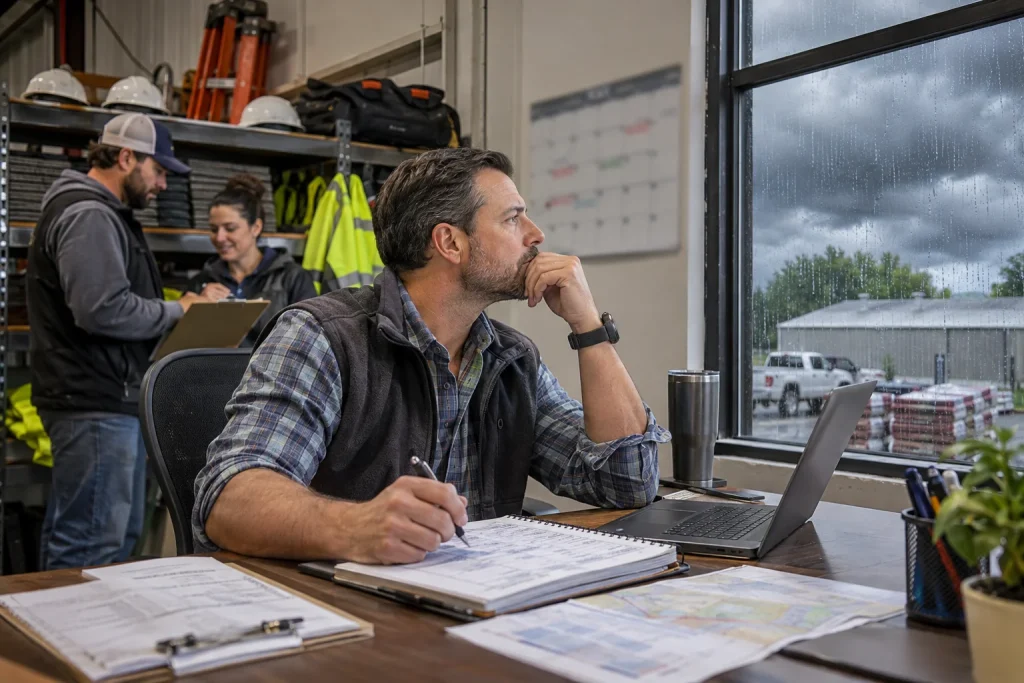
Schedule roofing work with a capacity calendar that subtracts the weather loss shown in your own logs, keeps a ready queue of jobs that can fill a lost day, and gives customers a window instead of a weatherproof promise. Weather is not an excuse for a late job; it is a known input. The Bureau of Labor Statistics notes that roofers usually do not work during bad weather and that northern-state work may slow in winter. The plan below is hypothetical and meant to be replaced with your numbers.
Step 1: compute real capacity
Nominal capacity is crews times working days. Real capacity subtracts days you have actually lost. Suppose you run 2 crews, 5 days a week, so nominal capacity is 10 crew-days. In your log, 14 of the last 120 scheduled crew-days were lost to weather, which is 14 / 120 = 11.7 percent. Bookable capacity is 10 x (1 – 14/120) = 8.83 crew-days a week. If you book 10, expect to spill 10 x 0.117 = 1.17 crew-days into the next week.
Use your own record, by season. A summer allowance applied in winter, or the reverse, will mislead you. If you have no history yet, start with a cautious placeholder and replace it as soon as you have a quarter of data.
Step 2: write go/no-go rules in advance
OSHA’s roofing guide says high winds, wet weather and icy conditions are especially hazardous, that employers should consider suspending operations in bad weather, and that roofing surfaces such as slate, tile, metal and some single-ply membranes can be particularly slippery when wet. The decision to stop belongs to the people responsible for safety, and it should be made by rule, not argued on the roof. Write a rule that names the conditions that pause work, the person who calls it and the time by which the call is made, so crews and customers hear the decision early.
Use forecasts as inputs. The National Weather Service defines probability of precipitation as the probability that precipitation will be reported at a certain location during a specified period of time. It is a probability, not a guarantee. Choose your own thresholds from your records and your safety rules; a figure borrowed from another company does not account for your roof types, crew or materials.
Step 3: plan for heat as well
OSHA’s heat guidance lists roofing among outdoor industries at risk, encourages water, rest and shade, recommends scheduling heavy work for the morning or using shorter shifts with frequent rest breaks, and says workers new to heat need time to acclimatize. Put heat rules in the calendar: shift start times in hot months, extra rest, and a lighter first few days for new or returning workers. That changes daily capacity, so reflect it in your calendar.
Step 4: keep a ready queue
A ready queue is a short list of jobs that are fully prepared: contract signed, permit if required, materials delivered, colors approved and customer notified. When weather removes a day from one job, the crew can move to a ready job whose conditions are suitable, instead of sitting idle. The queue only works if jobs are truly ready, so check the job packet before a job enters it.
Worked example: a week of bookings
| Job | Crew-days | Cumulative crew-days |
|---|---|---|
| Job 1 | 3 | 3 |
| Job 2 | 2 | 5 |
| Job 3 | 4 | 9 |
| Job 4 | 2 | 11 |
| Job 5 | 3 | 14 |
The queue totals 14 crew-days. At 8.83 bookable crew-days a week, that is 14 / 8.83, or about 1.6 weeks. Customers should therefore hear “your job is planned for the week of” and a confirmed date only after the day-before check, not a fixed date promised weeks ahead. The first week would fill Jobs 1, 2 and most of Job 3, leaving the rest for the following week.
Step 5: tell customers what to expect
- At signing: explain that dates are windows that depend on safe conditions, and say how and when you will confirm the start.
- Two to three days before: send a planned start with a note that weather may change it.
- The afternoon before: confirm or reschedule using the forecast and your rule.
- If a day is lost: tell the customer the same day, give the new plan and explain how the job is protected, without claiming conditions you cannot control.
Do not promise that work will finish before a storm unless you control the conditions, and avoid language such as “weatherproof by Friday.” Describe what you will do and what you will do if conditions change.
Failure cases
- Booking to nominal capacity so every lost day delays every customer.
- Skipping the ready queue and paying idle labor.
- Letting a customer or a schedule push a crew onto a roof the safety rule would pause.
- Applying one weather allowance year round.
Sources
Pages below were read on November 12, 2026. Rules, programs and warranty terms change, so confirm current details with the named agency or document before relying on them.
- OSHA: Protecting Roofing Workers (Publication 3755, 2015). Supports the statement that high winds, wet weather and icy conditions are especially hazardous for roofing, that employers should consider suspending operations, and that some roofing surfaces, including metal, are slippery when wet.
- OSHA: Heat overview. Supports the points about acclimatization, water, rest and shade, scheduling heavy work in the morning and planning for hot days.
- National Weather Service: Glossary entry for probability of precipitation. Supports the definition of probability of precipitation as the probability that precipitation will be reported at a certain location during a specified period.
- U.S. Bureau of Labor Statistics: Roofers, Occupational Outlook Handbook. Supports the statements that roofers usually do not work during bad weather and that northern-state roofing work may slow in winter.