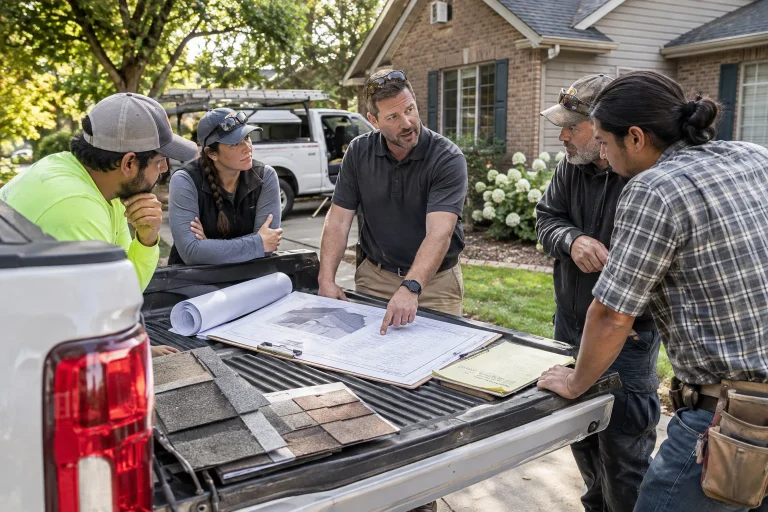
Qualify a roofing lead with a short intake form that checks fit, authority and timing, flags questions that need a different owner, and stops at a clear boundary: your staff schedule an inspection, and they do not diagnose a roof by phone, text or photo. The aim is to send an estimator only to jobs you can serve, in a window the customer can keep, with the right person present, and to decline or refer everything else politely. Nothing here is technical roofing advice.
The intake fields and why each exists
| Field | Why it matters | Action it drives |
|---|---|---|
| Property address and type | Service area and job types you accept | Outside area or type: decline or refer |
| Who is asking and their authority | The decision-maker must be present for the visit | If not the owner or manager, schedule when one can attend |
| What the customer wants, in their words | Repair, replacement, inspection or advice; not a diagnosis | Route to the right service line |
| Ground access and visit window | Whether an estimator can see and reach the property | Book a window; note gates, pets or restrictions |
| Desired timing and any deadline | Sale closing, event or season-driven urgency | Set expectations early |
| Open insurance claim? | Changes who decides scope and cost | Route to claim-aware script |
| Year the building was built | Flags a compliance question for older homes | Route to a compliance check |
| Rental, tenant or association involved? | Other approvals may be needed | Ask who must approve work |
Three routes that need another owner
Insurance claims. If a claim is open, the insurer’s process shapes the job. As a Texas example, checked November 12, 2026, the Texas Department of Insurance’s home insurance guide says the insurer’s adjuster determines the damage and estimates repair costs, that a contractor can talk to the adjuster about estimates and other issues, and that public adjusters must hold a state license. Rules vary by state. Staff should not advise on coverage, promise how a claim will turn out or act as the customer’s adjuster. They should note the claim status and schedule an inspection.
Older homes. Ask the year built and flag anything before 1978 for a compliance check. EPA’s lead-safe renovation program covers paid work that disturbs painted surfaces in housing and child-occupied facilities built before 1978, and requires certified firms. The EPA page does not say whether roofing is covered, so the intake flag is a prompt for your owner or compliance contact to decide. Do not guess in the intake call.
Emergencies. If a caller describes an immediate danger to people, such as a collapse or fire, tell them to contact emergency services. Roofing intake is not an emergency service. Decide in advance what, if anything, your company offers for urgent weather damage, and write the exact words staff use.
The diagnosis boundary
Photos help an estimator prepare, but remote guesses create liability and false expectations. Give staff a script: “I can schedule someone to inspect. I can’t say what’s causing it or how long a repair will take until we’ve seen it.” Forbidden statements: cause of a leak, remaining roof life, whether a repair or replacement is needed, or price. Allowed statements: what the process is, how long the inspection takes and what the customer should have ready.
Collect only what you need
The FTC’s personal-information guide says to keep only what you need for your business and to protect what you keep. For a first call, name, address, phone, email, preferred time and the answers above are enough. Ask for insurance claim details, if at all, only when the estimator needs them, and never ask for Social Security or payment card numbers at intake.
A fit rule with a worked example (three hypothetical leads)
Treat three fields as gates: in service area, in job type, and a reachable decision-maker. If any is no, do not book. For the rest, use a simple note rather than a score, since over-engineered scoring pretends to precision.
| Lead | What intake found | Decision |
|---|---|---|
| Lead 1 | In area, replacement inquiry, owner available Thursday afternoon, no claim, built 2008 | Book an estimator for Thursday |
| Lead 2 | In area, wants a repair, open claim, adjuster visit not yet done | Book an inspection after confirming the claim status and who will attend; do not advise on the claim |
| Lead 3 | Outside area, tenant calling for a landlord | Decline politely, offer to speak with the owner if in area |
Measure the intake
- Booked-to-attended rate. If 20 appointments are booked and 16 attended, that is 16 / 20 = 80 percent. Low attendance suggests a weak confirmation step or the wrong person on the call.
- Decline reasons. A pattern of out-of-area calls may mean your marketing is reaching the wrong places.
- Estimator surprises. Each time an estimator finds something the intake should have caught, add or reword a field.
Sources
Pages below were read on November 12, 2026. Rules, programs and warranty terms change, so confirm current details with the named agency or document before relying on them.
- Texas Department of Insurance: Home insurance guide. Used as one Texas example: the insurer’s adjuster determines the damage and estimated repair cost, a contractor can talk to the adjuster, and public adjusters must hold a state license. Rules in other states differ.
- U.S. EPA: Lead Renovation, Repair and Painting Program. Supports the description of the federal lead-safe renovation rule for paid work that disturbs paint in pre-1978 housing and child-occupied facilities. The page does not say whether roofing work is covered.
- Federal Trade Commission: Protecting Personal Information, A Guide for Business. Supports the principles of collecting and keeping only the personal information you need and protecting it.