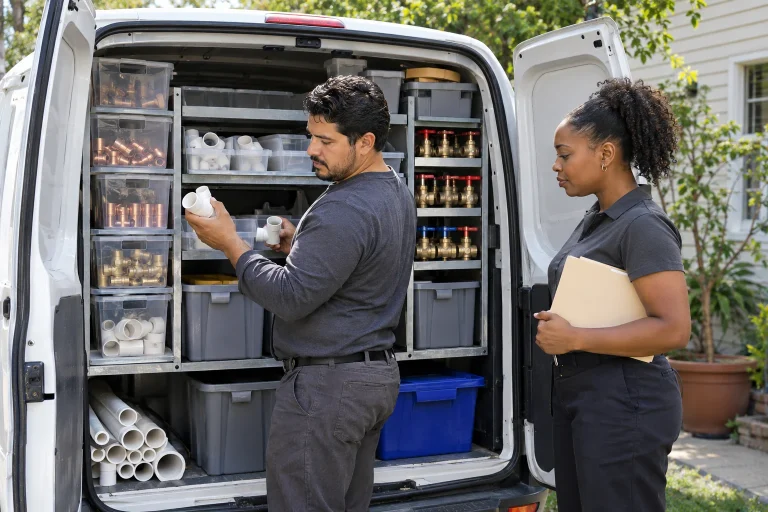
A plumbing startup budget has three parts: one-time purchases, monthly fixed costs that continue whether or not the phone rings, and a cash reserve sized to those monthly costs. The van is usually the biggest single line in the first part, but it is not the number that decides whether you survive month three.
Every dollar figure below is hypothetical and chosen to make the arithmetic visible. They are not averages, quotes or advice about what a van, tools or insurance cost. License, bond and insurance amounts in particular must come from your state or local agency and your insurance agent.
Why three buckets instead of one total
The SBA’s startup-cost guidance separates one-time expenses from monthly ones and says to count at least one year of monthly expenses, with five years ideal. It also suggests adding a cushion of about 10% for unpredictable costs, and notes that semi-variable costs should be split into fixed and variable parts. Those are in the SBA startup cost guide. A plumbing budget follows the same logic: a van purchase is one-time cash, a van payment is monthly fixed cost, and fuel is variable.
Bucket 1: One-time launch costs (hypothetical)
| Line | Hypothetical amount | Note |
|---|---|---|
| Vehicle down payment | $7,000 | Remainder financed |
| Shelving and storage upfit | $2,000 | Needed to stock parts safely |
| Hand and power tools | $6,500 | Subtract tools you already own |
| Specialty and diagnostic equipment | $2,500 | Buy only for work you sell now |
| Opening parts and fittings stock | $3,000 | See the van-stock article for sizing |
| License, registration, bond and permit fees | $1,500 | Placeholder; use the agency’s published figures |
| Vehicle lettering | $600 | Some states require company name and license number on vehicles |
| Phone and software setup | $400 | |
| Basic website and printed materials | $900 | |
| Safety gear and training | $700 | |
| Total one-time | $25,100 | 7,000 + 2,000 + 6,500 + 2,500 + 3,000 + 1,500 + 600 + 400 + 900 + 700 |
Two lines deserve a source check. The Texas board says service vehicles of a licensed company must display the company name and the Responsible Master Plumber’s license number, so lettering is a requirement there rather than a branding choice (TSBPE page, checked November 12, 2026). And OSHA’s construction quick start lists motor vehicles among the leading hazards and tells employers to train employees, which is why a safety line belongs in the budget even for a one-truck company (OSHA quick start).
Bucket 2: Monthly fixed costs (hypothetical)
| Line | Per month |
|---|---|
| Vehicle payment | $650 |
| Commercial auto and liability insurance | $520 |
| Phone and software | $190 |
| Bookkeeping | $250 |
| License and bond renewals, spread monthly | $125 |
| Baseline marketing | $400 |
| Tool repair and replacement set-aside | $150 |
| Total fixed | $2,285 |
Fuel, disposal fees and materials are left out because they rise and fall with job count. Track them per job, not per month.
Bucket 3: The reserve and the cushion
Choose how many months of fixed cost you want in the bank before the company has steady collections. Here the owner picks three months: 3 × $2,285 = $6,855. Then add the SBA-style 10% cushion over the sum of the one-time list and the reserve:
- One-time plus reserve: $25,100 + $6,855 = $31,955
- 10% cushion: $3,195.50
- Cash to have before launch: $35,150.50
The van-related lines (down payment, upfit, lettering) total $9,600. That is 38.2% of the one-time list but only 27.3% of the full $35,150.50 requirement, and the monthly payment is 28.4% of the fixed costs. The van matters, but the other 72.7% of the requirement is where underfunded launches get stuck.
Stress test: what if the van costs more?
Suppose a bigger van adds $10,000 of financing. Using an illustrative 8% rate over 60 months (not a lender quote), the added payment is about $202.76 a month. Fixed cost rises from $2,285 to $2,487.76, an increase of 8.9%. The three-month reserve rises to $7,463.28, which is $608.28 more. Notice that the extra $10,000 of van costs the plan roughly $202.76 every month plus a larger reserve, not a one-time $10,000. That recurring effect is why financing choices belong in the fixed-cost bucket.
Actions before you commit
- Replace each placeholder with a written quote or an official fee schedule.
- Subtract tools you already own, but note replacement dates.
- Run the budget twice: with your hoped-for job count and with half of it.
- Decide the one line you will not fund yet. Specialty equipment is a common candidate.
How the budget fails
It fails when licensing costs are guessed, when the reserve is skipped because the first jobs “should” pay quickly, or when the owner’s own pay is left out of the fixed costs. This version has no owner draw, so if you need household income from month one, add it as a line and recompute the reserve.
Sources
- SBA: Calculate your startup costs, checked November 12, 2026
- Texas State Board of Plumbing Examiners: Responsible Master Plumber, checked November 12, 2026
- OSHA: Construction Industry Compliance Assistance Quick Start, checked November 12, 2026