Before offering cross-border fulfillment, establish where the product ships from, where it may be delivered, who handles the shipment documentation, and which charges the customer may face. Confirm the return route as carefully as the outbound route. Do not assume that a supplier’s worldwide-shipping statement answers these questions.
Evaluate a specific product and destination rather than “international sales” as one category. Product eligibility, documentation, costs, and delivery conditions vary. Obtain current guidance from the relevant authorities, carrier, and qualified advisers for the actual route.
Identify the physical origin of the order
A supplier’s headquarters, billing location, and dispatch warehouse can be different places. The product’s manufacturing origin is another distinct fact. Record each where relevant and ask what happens if the supplier routes the order from another facility.
Shopify’s international guidance explains that duties and import taxes can affect what a customer is charged on arrival or at checkout. CBP’s package-help guidance distinguishes carrier tracking from customs detention and advises contacting the carrier for location information. These sources support asking precise route and responsibility questions rather than assuming every international delay or charge has the same cause.
Use a route worksheet
| Question | Evidence to obtain |
|---|---|
| Where will this variant dispatch? | Warehouse, available service, and rerouting conditions. |
| Is this destination supported? | Current supplier, carrier, platform, and product-specific confirmation. |
| Who prepares documentation? | Responsible party, accurate product details, and escalation contact. |
| Who pays which charges? | Written allocation of shipping, import-related, and handling charges. |
| Who tracks an exception? | Carrier reference, supplier support route, and customer-update owner. |
| Where can a return go? | Authorized destination, process, and likely transport implications. |
Keep unknown answers visible. A checkout setting that displays an estimate does not settle every operational or jurisdictional question. Ask the appropriate professional to resolve uncertainty about importer responsibilities, classification, taxes, or product requirements.
Worked example: a poster shipped from two facilities
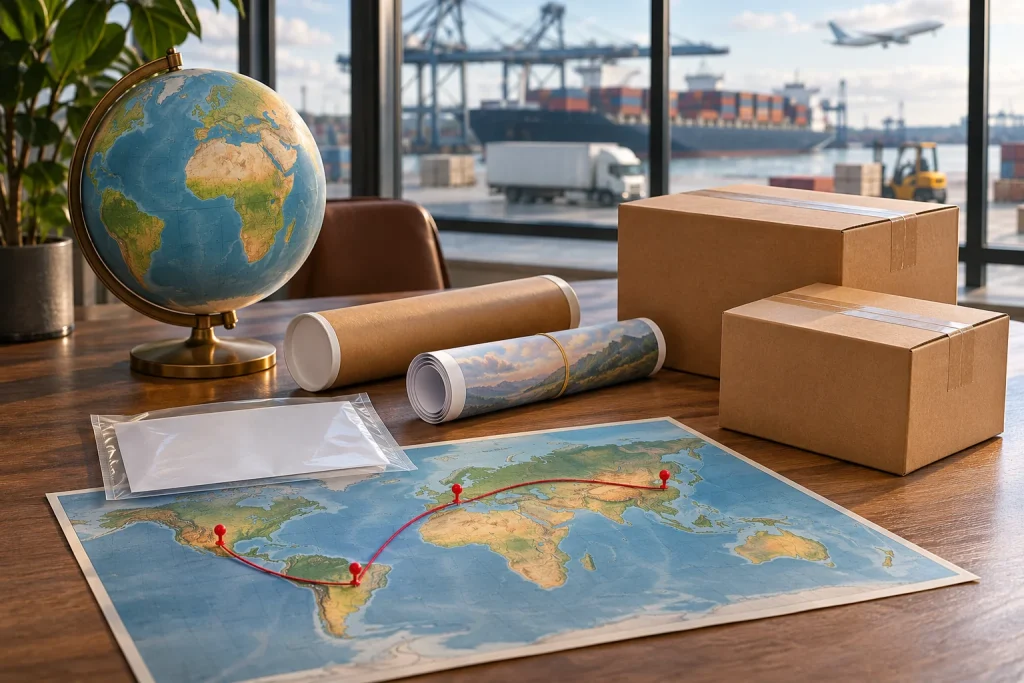
Imagine a hypothetical store selling an original illustrated poster. Its supplier normally fulfills customers in one region from a nearby facility, but some sizes are routed from another country. The store plans to make a single shipping statement for the whole range.
The seller discovers that the larger size uses a different route and return destination. It therefore evaluates the sizes separately. The customer-facing information must reflect the actual supported arrangement rather than borrowing the nearby facility’s timing for every variant.
For the cross-border route, the seller asks who prepares shipment documents, what information the supplier needs, and which party communicates about any additional charge. If those answers remain unclear, the seller keeps that destination or variant unavailable while the questions are resolved.
This is a hypothetical planning example, not a statement that a particular poster shipment qualifies for any exemption or tax treatment. No duty threshold or clearance outcome can be inferred from the product’s low price or apparent simplicity.
Separate transport estimates from clearance assumptions
Record processing, dispatch, carrier transport, and any additional route steps distinctly. Ask whether the quoted service time includes every stage or only transit after carrier acceptance. Consider weekends and holidays applicable to more than one location.
When a package stalls, use the latest confirmed event. A supplier saying “customs delay” is not enough to establish that an authority detained it. Obtain the carrier’s status and the relevant reference, then follow the appropriate support route without inventing an explanation for the customer.
Plan recovery across the same border
A low-cost outbound service may have an expensive or impractical return route. Establish whether the supplier accepts returns, whether authorization is required, and who provides the correct instructions. Keep the seller’s customer remedy separate from supplier reimbursement.
Consider a damaged item, an incorrect address, and an unclaimed parcel as different cases. Each may follow a different operational path. Do not publish a return address that has not been confirmed for the selected product and destination.
Make the expansion decision route by route
Proceed only when the product information, charge allocation, documentation responsibility, delivery evidence, and recovery plan support the offer. Review official requirements close to launch because cross-border rules and carrier conditions change. Start with a route you can supervise, preserve unresolved questions, and avoid treating a supplier’s broad coverage map as a complete business plan.