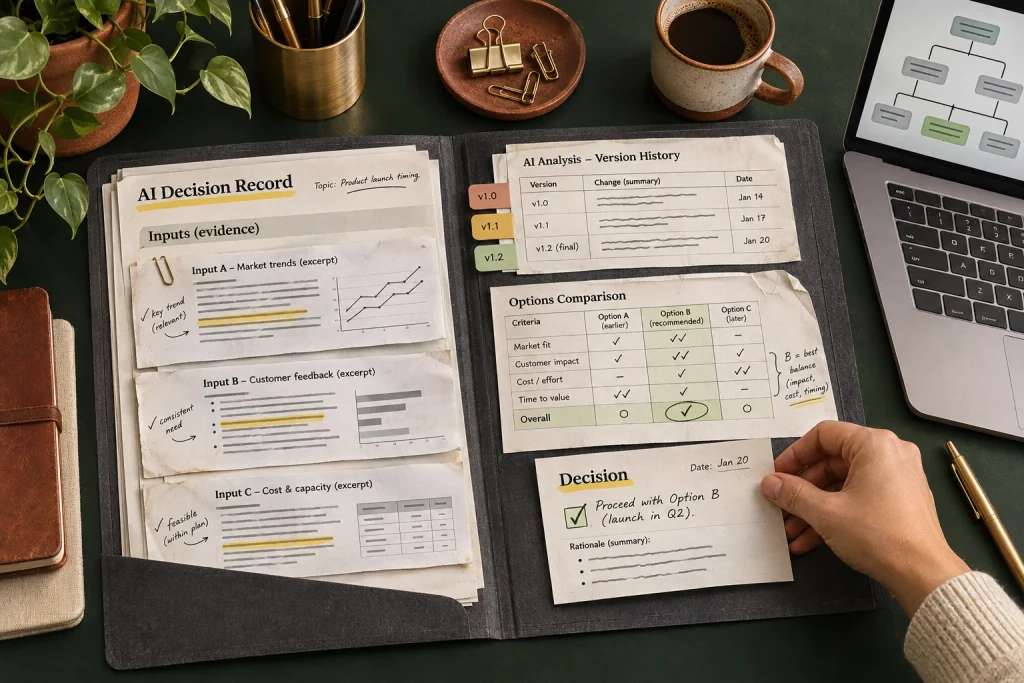
Keep a compact evidence pack for each material AI-suggested business decision: the question being considered, the relevant input references, the configuration used, the recommendation produced, the review outcome, and what actually happened. Give the pack a stable case identifier so those records can be joined later without relying on someone’s memory.
A chat transcript alone is not enough. It may omit which policy was retrieved, which facts were current, whether a person approved the proposal, or whether an attempted action succeeded. The purpose of the pack is reconstruction. It should help a later reviewer separate a bad suggestion, a bad input, a missed review, and an execution failure.
Decide which decisions need a pack
Use a pack for recommendations whose consequences justify later reconstruction: a proposed service exception, a customer-facing adjustment, a changed operating priority, or another material action selected with AI assistance. Define that threshold with the process owner. A routine spelling correction need not produce the same record as a proposed change to a customer’s service arrangement.
Keep a lightweight run identifier for ordinary work so you can find failures, but do not collect a large dossier just because storage is available. The evidence depth should match the decision and the questions you may reasonably need to answer.
Use a reconstruction checklist
| Part | What to preserve | Question it answers |
|---|---|---|
| Decision request | Case ID, requested outcome, responsible owner, time | What was the assistant asked to help decide? |
| Relevant inputs | Record references, pertinent facts, source versions, retrieval time | What information was available? |
| Configuration | Instruction version, model identifier, tool and rule versions | Which setup produced the suggestion? |
| Recommendation | Actual output, cited evidence, stated uncertainty | What did the assistant propose? |
| Review | Reviewer identity or role, outcome, modifications, time | What did an authorized person accept or reject? |
| Execution | Action ID, parameters reference, result, subsequent correction | What changed in the business system? |
The W3C PROV Overview describes provenance in terms of the entities, activities, and people involved in producing something. That is a useful organizing idea for this pack. You do not need to adopt its technical formats, and this suggested checklist is not a claim of compliance with a particular audit standard.
Preserve inputs without duplicating every record
A live link to a customer record shows the record now, not necessarily what it showed when the recommendation was made. For a fact that determines the outcome, preserve an appropriately controlled version reference or the necessary dated value. For a policy, identify its version or effective date rather than linking only to a page that will be overwritten.
Balance reconstruction against minimization. Keep a reference to a protected source where that source’s history is reliably retained and accessible to the reviewer. Where it is not, select a limited authorized snapshot of the relevant evidence. Do not copy full inboxes, identity documents, payment credentials, or unrelated customer history into a general logging system.
Record the suggestion and the action separately
Preserve the output actually received, not a tidied summary written after the result is known. If a reviewer changes the suggestion, record the changed proposal and the review decision. A rejected recommendation remains rejected even if another action is later approved for the same customer.
Then link the business system’s execution result. “Approved,” “attempted,” “completed,” and “uncertain” are different states. A timeout after an update request does not prove that nothing changed. Preserve the uncertainty and the later verification rather than converting the timeout into a success or failure by assumption.
OWASP’s AI Agent Security Cheat Sheet recommends structured decision metadata for high-risk actions, including authorization outcomes, approval identifiers, execution results, and policy versions. The proposed pack applies that narrow logging principle to an owner’s review process; it does not make a saved approval note an authorization mechanism.
Hypothetical example: a recommendation that was changed
Suppose an assistant reviews a service complaint and suggests an extra visit. The evidence pack links the complaint excerpt, the dated service record, the applicable remedy policy, and instruction version 4. It preserves the suggestion and its stated reason. A supervisor reviews it, sees that the missed work was already completed, and rejects the extra visit.
The supervisor instead approves a corrected completion report. The pack records that separate action and the delivery result. A later reviewer can see that the AI proposal was not followed, why it was rejected, and what the customer actually received. This is an invented scenario with no claimed real customer outcome.
Choose access and retention deliberately
Limit editing and reading to the roles that need the pack. Keep a dated history of material corrections rather than silently rewriting the original recommendation. If the record references sensitive source material, the link must not grant broader access than the source permits.
The FTC advises retaining personal information only for a legitimate need and having a written retention and disposal policy. Apply that discipline to evidence packs too. Agree retention with the appropriate business, privacy, and legal owners where obligations matter. A useful review record is not a reason to retain unnecessary personal details forever.
Try a reconstruction exercise
- Select an invented case and create the pack as the workflow runs.
- Give an authorized colleague only the pack and its permitted source links.
- Ask them to identify the input facts, versions, proposal, review, and actual action.
- Note missing evidence, inaccessible references, or ambiguous states.
- Fix the capture process before relying on it for consequential work.
The exercise checks whether the record is understandable. It does not prove that rerunning the same model will produce an identical answer. Reconstruction explains a past decision; exact model reproducibility is a separate question.
Sources
- PROV Overview (W3C): provides the general provenance concept of entities, activities, and people.
- OWASP AI Agent Security Cheat Sheet: supports structured metadata about high-risk actions and their review and execution.
- Protecting Personal Information: A Guide for Business (FTC): supports necessary collection, written retention, and secure disposal.