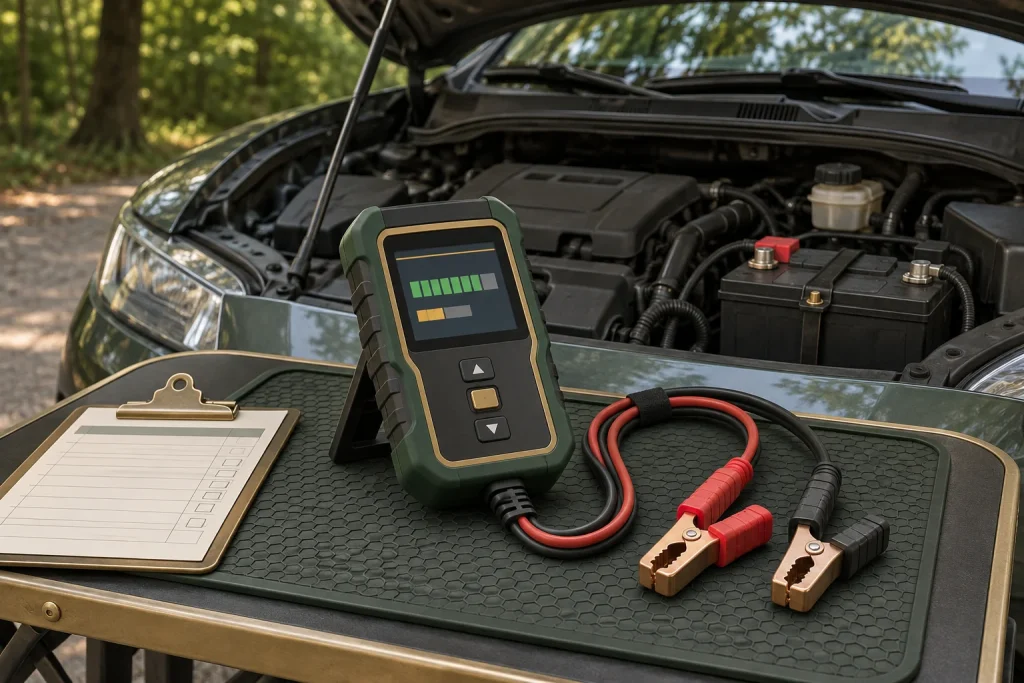
A mobile battery-testing service should sell a defined assessment using appropriate equipment and competent procedures, followed by a clear record of what was tested and what remains unresolved. It should not promise to repair a vehicle, guarantee future starting or diagnose every electrical fault. Choose a supported vehicle and battery scope before accepting visits.
Limit the initial service deliberately
For example, a suitably trained operator might define a service for specified low-voltage starting-battery types in conventional vehicles. That is a business scope choice, not permission to test every battery carrying a similar voltage label. Confirm the battery technology, vehicle requirements and tester compatibility from the relevant manufacturers.
Keep electric-vehicle traction systems, unfamiliar hybrid arrangements, damaged batteries and work beyond the operator’s competence outside the initial offer. A separate qualified specialist should assess those situations. This guide is an operating brief, not a tutorial for connecting test equipment, charging a battery or working on a vehicle.
Screen the request before travel
| Intake question | Decision it supports |
|---|---|
| Which vehicle and stated concern? | Whether the request fits the defined assessment |
| Which battery and access arrangement? | Compatibility and preparation questions for the operator |
| Where is the vehicle? | Whether a suitable working site is available |
| Who authorizes the work? | Permission and customer decision route |
| What output is expected? | Whether the buyer understands the report’s limits |
Do not accept a roadside emergency as an ordinary driveway appointment if the business is not equipped and authorized for roadside work. A vehicle in traffic, an unsuitable work area or a hazardous condition requires a different response. Explain the limitation before dispatch rather than relying on the technician to improvise.
Use the exact equipment procedure
Maintain the approved operating instructions for the tester and supported vehicles. Identify the training, condition checks and equipment maintenance needed before launching. Check jurisdiction and insurance requirements for the actual activity with appropriate official sources and advisers.
Interstate Batteries’ IB Pulse manual illustrates that testing has equipment-specific inputs and result categories, including outcomes that require further work or retesting. Hyundai describes technician assessment using dedicated equipment and several indicators. Neither source establishes that buying a portable tester gives someone the skill to perform every diagnostic service.
Keep the report factual and bounded
Record the vehicle reference needed for the job, date, relevant battery identity, equipment used, selected test context and the actual output. Preserve the manufacturer’s wording where necessary to interpret that result, without converting it into a broader warranty.
Distinguish a completed supported test from an assessment that could not be completed, an uncertain input or a result requiring another step. Do not turn an inaccessible battery or an unresolved test into a confident pass. Protect personal information and avoid collecting a full identity-document set merely to create a report.
Hypothetical example: a result needing another step
Imagine a customer books an illustrative driveway visit because starting has become unreliable. The vehicle fits the operator’s declared scope and the site is suitable. The supported procedure produces a result requiring additional work and a retest rather than a final battery verdict.
The operator records that result and explains the appropriate qualified follow-up route. They do not label the battery permanently defective, promise the next start or begin charging or replacement outside the agreed service. The customer receives useful evidence with a clear next decision, even though the visit does not end in a repair.
Price the assessment and exceptions clearly
Include travel, compatibility checks, testing time, reporting and customer explanation. State what happens when the vehicle does not match the booking information or the site prevents the test. A failed attempt, an incomplete assessment and a completed report should not be indistinguishable to the customer.
If retesting is available, define whether it is included, separately booked or handled by another provider. Do not sell unlimited return visits under an attractive headline test fee. Similarly, disclose any relationship with a replacement supplier rather than presenting a sales referral as independent diagnostic proof.
Review whether the model remains useful
Track declined requests, incomplete visits, report questions and reasons for specialist referral. Repeated incompatibility may mean the intake needs improvement or the service boundary is poorly explained. It is not a reason to expand into unfamiliar vehicle systems without suitable expertise.
Use these observations to improve scheduling and customer expectations. Do not publish a failure-prevention percentage or claim a repair success rate from ordinary test records. A test service is credible when its evidence, limits and next steps remain understandable.
Before accepting a battery-test appointment
- The operator has the competence and appropriate procedures.
- Vehicle and battery eligibility are confirmed.
- The site supports the declared work.
- The customer understands the limited assessment.
- Incomplete and retest outcomes have a clear route.
- No unagreed charging, replacement or repair is implied.
- The report and referral preserve the actual result.