Choose the operating model before you compare phone-system brands. A hosted PBX, a unified communications service (UCaaS), and SIP trunks can all carry business calls, but they assign responsibility differently. The useful question is not which acronym is best. It is whether your business wants a provider to run a contained phone service, wants calling combined with collaboration software, or already has equipment and technical ownership that make separate SIP connectivity sensible.
That distinction affects administration, outage handling, devices, training and the work required when the business opens another site. Start with a one-page operating brief. List the people who answer calls, the numbers customers recognize, the locations involved, the devices that must work, and the person who will change routing after a departure or emergency. The brief lets you compare offers that otherwise look similar because they quote the same number of users.
Separate the three models
| Model | What the business is usually buying | Owner question to ask |
|---|---|---|
| Hosted PBX | A provider-operated business phone platform with extensions, routing and related calling features. | Which calling tasks remain ours after the provider configures the service? |
| UCaaS | Calling alongside messaging, meetings and collaboration features. | Do staff actually need those tools together, and who will administer identity and user access? |
| SIP trunks | Call connectivity to a PBX or application the business or its technical partner operates. | Who owns the PBX, security, updates, dial plan and incident response? |
Cisco’s small-business PBX overview distinguishes on-premises and cloud PBX approaches and is used here only for those broad architecture terms, not as an endorsement. SIP is a standards-track signaling protocol; RFC 3261 describes it as the Session Initiation Protocol. Neither source makes SIP trunks a default choice for a small business. Someone still has to operate the connected system and understand where the provider’s responsibility ends.
Use the current phone environment as evidence
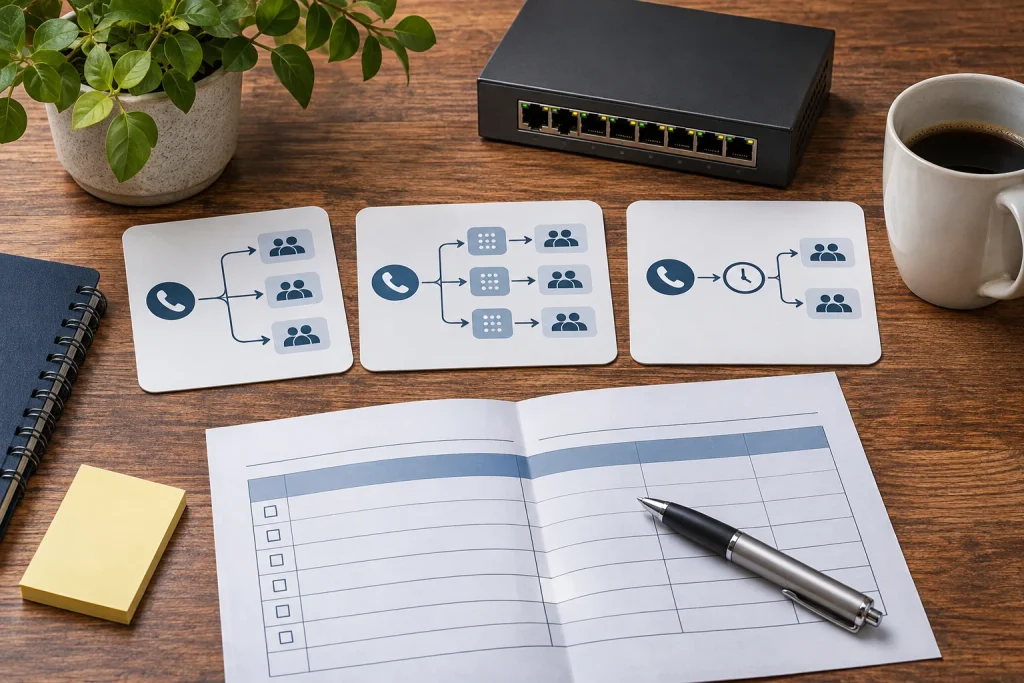
Count work patterns, not only seats. A five-person office with a reception desk, two field technicians and an after-hours answering process has different needs from five people who each make calls from a laptop. Ask who needs a physical handset, who needs a mobile app, who shares a number, who requires call queues, and who must receive an escalation when a caller cannot be served.
Also list what already exists. A business that has no PBX and no technical administrator should be cautious about buying a model that assumes it will run one. A business with an existing PBX, an experienced managed provider and a documented disaster-recovery process may have a legitimate reason to evaluate SIP trunks. The point is not to make the most sophisticated choice; it is to avoid acquiring an operating burden that has no owner.
Run a responsibility test before the price comparison
- For each model, write the owner for user setup, number changes, call routing, devices, billing questions and outages.
- Ask what happens if internet service fails at the office, a staff member leaves, or the primary administrator cannot sign in.
- Ask whether the provider configures emergency calling information and what the business must keep current.
- Confirm how existing numbers, recordings and routing data can be retrieved if the service changes.
- Test the proposed call flow with the staff who actually answer callers.
Microsoft’s Network Planner documentation is a useful example of the inputs that matter for cloud voice planning: sites, network users, WAN capacity, internet egress and PSTN egress. It is documentation for Microsoft Teams, not a recommendation to buy Teams. Its useful lesson is that a calling service operates across locations and network conditions, not just a pricing table.
A hypothetical comparison
Consider an invented seven-person HVAC company. Two staff members schedule work from one office, four technicians answer customer callbacks on mobile devices, and the owner receives overflow calls during a seasonal surge. The company has no internal phone engineer. It needs a main number, a small queue, mobile calling, voicemail coverage and a clear way to change routing when an employee leaves.
A hosted PBX or UCaaS service may be simpler to evaluate because the operating brief assigns less PBX maintenance to the company. The deciding question between those two is whether the company will actually adopt the collaboration layer and can manage its user identities. SIP trunks might be sensible only if a qualified provider will own the PBX and document the boundary. A low trunk price would not offset an unowned dial plan, unknown emergency-calling configuration or a broken after-hours route.
Ask provider questions that expose the operating burden
- Who has the master account, and how is access recovered if that person leaves?
- Which tasks can the business complete without opening a support ticket?
- Which devices, browsers and mobile operating systems are supported for the work pattern described?
- How are call queues, holidays and after-hours routes tested before they go live?
- What is the documented port-out and export process if the business changes service?
- What provider support is included when a call-quality issue may involve the local network?
Do not accept a verbal answer as the whole plan. Save the answer with the proposal, name the business owner for each responsibility, and turn the final routing design into a short runbook. For the customer-facing side of the system, pair this work with a clear inbound inquiry-routing process so a well-configured phone system does not simply send callers to an unprepared team.
Make the selection reversible
Before signing, confirm the account owner, number inventory, administrator recovery process and exit questions. A phone-system decision is easier to change when the business knows which numbers it owns, where settings are recorded and who can authorize a port. That is more valuable than a generic feature score because it preserves the ability to serve callers during a later change.
Sources
- Small Business PBX: The Basics (Cisco)
- RFC 3261: SIP: Session Initiation Protocol (RFC Editor)
- Use the Network Planner for Microsoft Teams (Microsoft Learn)