Add a second van only when your own records show jobs you are turning away, when a credentialed person can legally lead the second truck, and when your cash can carry the weak-demand scenario for six months. A busy owner and a full calendar are not enough. A second van is a second fixed-cost structure, and it needs its own supervision, parts replenishment and customer pipeline.
All numbers are hypothetical and show the method. Credential examples name their jurisdiction and are dated as checked November 12, 2026.
Gate 1: Demand evidence from your own log
For eight weeks, record every job you declined, rescheduled beyond a stated lead time, or lost because you could not offer a slot. Also track the average working days from booking to the first available appointment. Suppose you log 60 turned-away jobs in eight weeks. Eight weeks is about 1.85 months, so that is 60 ÷ 1.85 = 32.5 jobs a month. Not every one would have converted. If you assume a 60% win rate, incremental demand is 32.5 × 0.60 = 19.5, call it 20 jobs a month. That is evidence of the conservative case only. If a larger case depends on a new service area or a new product such as maintenance plans, label it as an assumption you have to earn.
Gate 2: A credentialed lead for the second truck
Capacity is not just a vehicle and a person who can drive. Washington’s labor agency says a licensed plumbing contractor designates a certified plumber, who may be an owner, partner or full-time employee (Washington L&I). The Texas board says a Responsible Master Plumber must ensure everyone performing plumbing work holds a current license or registration, and that a licensee is present and directly supervising where registrants are working (TSBPE RMP page). If your second technician is a registrant under direct-supervision rules, the second van is not independent capacity at all. It is a helper, and your lead technician’s time is still the constraint. Confirm what your own board requires before building any model.
Gate 3: Build three separate capacity scenarios
Do not average the cases. Model each and decide whether you can survive the lowest.
Inputs (hypothetical): revenue per job $430, materials $75, variable vehicle cost $60, giving a contribution of $295 a job before labor. Fixed monthly cost of the second van: technician loaded wage $5,800, plus $2,100 for vehicle payment, insurance, software, extra stock carrying cost and supervision time. Total fixed: $7,900. Break-even jobs = $7,900 ÷ $295 = 26.8, so 27 jobs a month.
| Scenario | Incremental jobs a month | Contribution | After $7,900 fixed |
|---|---|---|---|
| Conservative (turned-away evidence) | 20 | $5,900 | -$2,000 |
| Base (needs a new source of demand) | 36 | $10,620 | +$2,720 |
| Strong | 48 | $14,160 | +$6,260 |
The evidence supports only the conservative case, which loses money. So the real question is: can you fund it? Upfront: $7,000 down payment, $2,000 upfit, $5,000 tools and $1,500 opening stock total $15,500. Six months of the conservative loss is 6 × $2,000 = $12,000. Cash required to survive the weak case is $27,500 before any ramp-up slowness. If that number is uncomfortable, the right answer is to delay, or to start with a part-time or used-vehicle approach that removes some fixed cost, and use the time to create the demand the base case needs.
Gate 4: Scheduling and supervision capacity
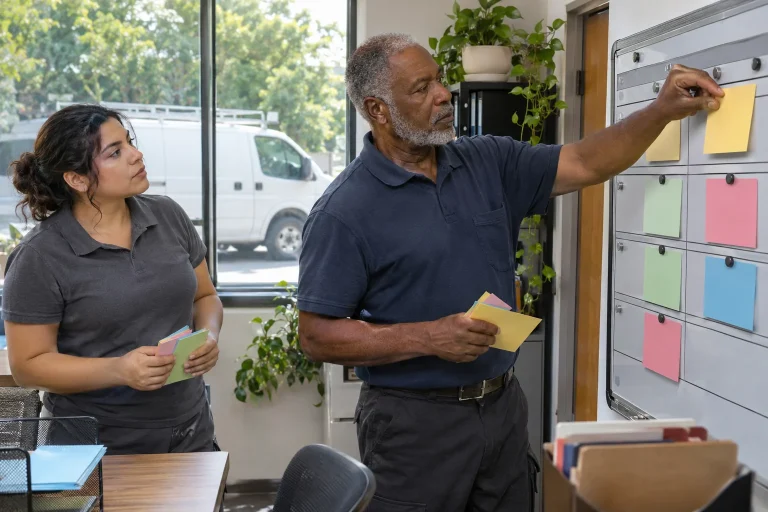
Ask who dispatches the second truck, who handles its call-backs and who approves its estimates. The SBA’s hiring guide lists the payroll and compliance steps of a new hire, including tax IDs, withholding paperwork, payroll service, records and workers’ compensation, and warns that misclassifying a worker as an independent contractor can create back taxes and penalties (SBA: Hire and manage employees). Have a professional confirm the status of your second technician before the first day. Then add the owner’s time to the model: if supervision plus dispatch takes ten hours a week from the owner, decide whether those hours come from billable work or from rest.
Gate 5: Parts replenishment
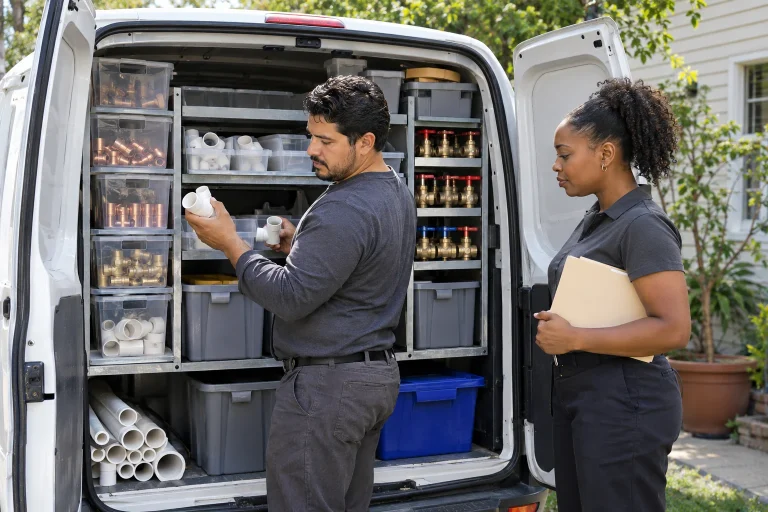
Two vans roughly double restock runs and miss events. Assign one person to own the replenishment routine and one rule for how the second truck’s minimums are set. If the second van has the same stock list as the first, you have doubled carrying cost without learning whether that mix fits the new routes.
Decision summary
| Gate | Evidence that passes | Result in this example |
|---|---|---|
| 1. Demand | Turned-away log supports at least the break-even job count | Fails: 20 versus 27 needed |
| 2. Credential | Named lead allowed by the board to supervise the truck | Pending |
| 3. Cash | Conservative case funded for six months | $27,500 needed |
| 4. Supervision | Dispatch, estimating and call-back owners named | Pending |
| 5. Parts | Replenishment owner and stock list for the second van | Pending |
In this hypothetical, the right call is not yet. The company has enough evidence to keep logging demand and perhaps to test a maintenance plan, not enough to buy a truck.
How this analysis fails
It fails if the turned-away log is reconstructed from memory, if the win rate is optimistic, or if the new technician’s first months are modeled at full productivity. Rerun the table with the last three months of real numbers every time you revisit the decision.
Sources
- Washington L&I: New plumbing licensing requirements, checked November 12, 2026
- Texas State Board of Plumbing Examiners: Responsible Master Plumber, checked November 12, 2026
- SBA: Hire and manage employees, checked November 12, 2026