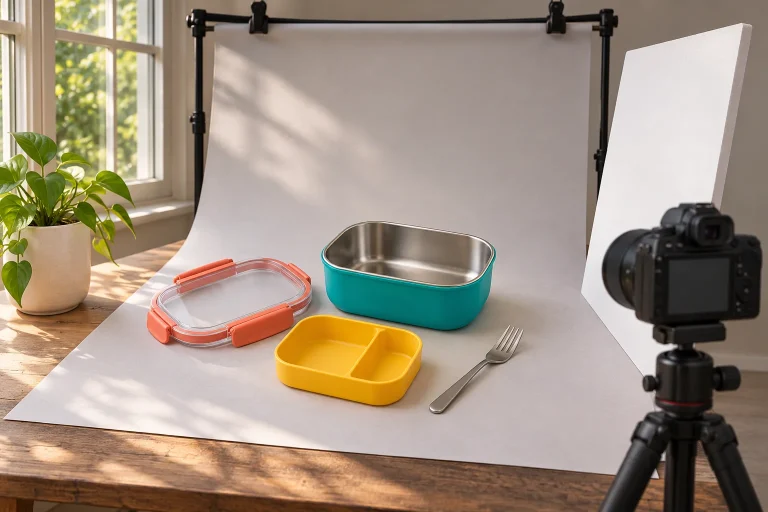
Build a product-photography service around a defined set of images and a repeatable production process. Specify the product types, shots, editing, revisions, delivery files, and usage arrangement before quoting. “Photograph twenty products” leaves too many decisions unresolved to estimate reliably.
A small studio can start with a narrow category whose lighting, preparation, and handling it can support. Simple packaged goods, reflective jewelry, large furniture, food, and apparel involve different equipment and skills. Avoid presenting an attractive sample as proof that you can handle every category.
Choose the customer’s actual use
Ask whether the images are for a retailer’s catalog, a marketplace listing, packaging, social content, or another use. The intended destination affects composition, backgrounds, crops, and delivery. Identify the person who approves the images and any brand or platform requirements they must satisfy.
Shopify’s media guidance distinguishes product assets and explains how they are added and used. Adobe’s product-photo workflow documentation uses a shot list, product identifiers, review, and approved assets. You can apply those planning principles without buying either system or promising a particular platform will accept every file.
Create a shot list before production
| Shot-list field | Why it matters |
|---|---|
| Product identifier | Connects each image to the correct item or variation |
| Required view | Defines angle, detail, scale, or packaging coverage |
| Background and styling | Sets the visual treatment being priced |
| Destination | Identifies file and composition requirements to verify |
| Approval reference | Records the sample treatment or agreed direction |
Clarify whether color variations need separate photography and whether packaging is part of the item. Check current official destination requirements rather than relying on an old image-size cheat sheet. If the client wants a new visual treatment after approving the sample, assess it as a change.
Control the physical product journey
Record what arrives, its condition, quantity, identifier, and any special handling instructions. Agree on who prepares the products, who supplies props, and what happens to samples afterward. Confirm whether products are returned, stored temporarily, or otherwise handled with authorization.
Discuss suitable insurance and premises arrangements with the relevant professionals. Do not accept hazardous, unusually valuable, perishable, or regulated items simply because they are small enough to fit on a table. Their handling may require a different business setup.
Price production beyond shutter time
Include intake, cleaning or preparation within scope, setup, styling, lighting tests, photography, selection, retouching, client review, export, naming, and product return. Decide whether your offer is priced by image, product, production time, or a package, and state the assumptions.
In a hypothetical job, ten products each need a front, back, and detail image. That creates thirty final images before alternate crops or revisions. If the client later requests two color variants of each item, the new work may be more than a small editing change. This example illustrates scope arithmetic, not expected production speed.
Approve a representative sample
Before completing a larger batch, obtain approval of a representative product treatment. Show the relevant background, angle, crop, and editing level. Make clear whether the sample is final or still provisional.
Set a review process that consolidates feedback from the authorized client approver. Explain which corrections are included and how requests for new shots or styling are assessed. Distinguish a technical correction from a new creative direction without turning every comment into a dispute.
Deliver organized, usable files
Use consistent names linked to the product list. Confirm formats, dimensions, crop variants, and file-transfer method appropriate to the destination. Include a delivery manifest so the client can see which required images are complete.
Keep source files, approved finals, and public portfolio material distinct. Obtain the appropriate permission before using client products or images in your marketing. Have the relevant professional review intellectual-property and usage terms rather than assuming the client understands a generic phrase such as “full rights.”
Include a correction check that compares the delivery manifest with the original shot list. Count missing product views separately from files needing a technical re-export. This helps both sides distinguish incomplete production from a delivery-format issue, and gives the next batch a clearer quality target.
Validate a repeatable category
Create honest samples using products you may photograph and share. Label self-initiated portfolio work accurately. Track actual time by production stage and review whether clients can use the delivered files without renaming or requesting missing views.
Check local business and studio requirements before paid work. Expand only when the production record supports a broader category or higher volume. A useful product-photography service delivers accurate, organized assets through a process the customer can understand.