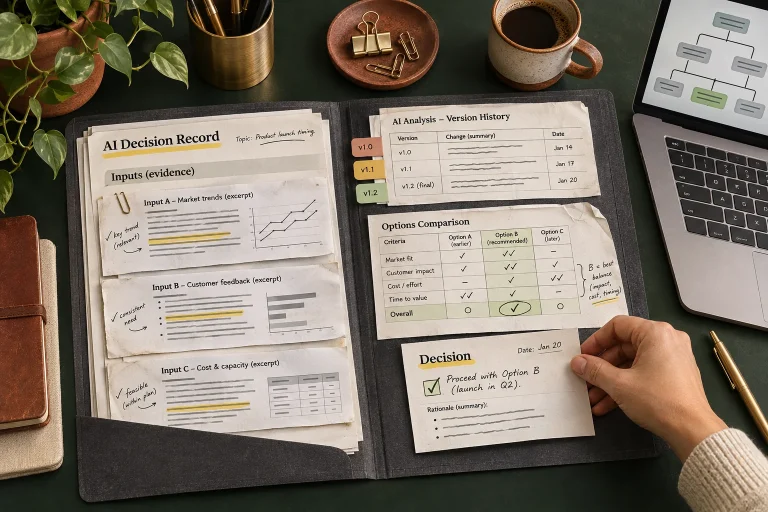
Review AI product translations against an approved product fact sheet before publishing them. Keep SKU identity, material claims, measurements and exclusions fixed while a reviewer checks whether the translated wording preserves the same meaning. Localized copy may sound natural and still describe a different product.
Use AI to prepare a translation draft, terminology questions and a comparison card. Assign final review to someone capable of assessing the target language and product context. A second AI translation back into the original language can flag questions, but it does not establish that the customer-facing text is correct.
Protect the product facts before translating prose
Start with the seller’s approved source record, not a competing product’s translated page. Record the exact SKU and variant, source version, target language and market. A language alone may not identify the intended audience; vocabulary, measurement conventions and commercial expectations can differ between markets using the same language.
Prepare a short terminology list containing brand-approved product names, materials, included components, technical identifiers and phrases that must keep a narrow meaning. Mark identifiers that must remain unchanged. Translation should not alter a model number because it resembles an ordinary word.
For a hypothetical furniture item, the source says “oak veneer over an engineered-wood core.” If the draft conveys “solid oak,” the issue is a changed material claim, not a stylistic preference. Hold the translation and resolve it against the source. A more attractive description is not permission to change what the customer is buying.
Use a review card for each product and locale
| Review field | What to check |
|---|---|
| Product identity | SKU, variant and included components match the source. |
| Protected facts | Material, capacity, dimensions, compatibility and exclusions retain their meaning. |
| Measurements | Original value, displayed unit, any conversion rule and rounding are recorded. |
| Terminology | Approved terms are used consistently; unresolved phrases are flagged. |
| Customer meaning | Instructions and limitations are understandable in the intended locale. |
| Release status | Reviewer, source version and unresolved questions are visible. |
Keep source text and translated text side by side. Give each flagged phrase a reason and an owner. “Needs language review” and “source specification missing” are different problems; the translator cannot fix a fact the seller has never verified.
Keep unit conversion separate from translation
Changing the language does not necessarily require changing units. If the target market needs different units, use an approved conversion method and review the displayed precision. Ask the AI to preserve the original measurement alongside any proposed conversion until it is checked.
In a hypothetical product record, a shelf is 120 centimeters wide. Displaying 1.2 meters preserves the same measurement because 120 ÷ 100 = 1.2. Displaying 120 meters is a hundredfold error. Even a correct conversion may be unhelpful if it obscures a tight fit tolerance, so the product owner must decide the presentation.
Do not convert model numbers, package counts or size labels as though they were measurements. A size designation can be a commercial label rather than a direct unit conversion. Keep the variant selector and description consistent.
Check the platform’s actual translation boundaries
As checked November 6, 2026, Shopify’s automatic-translation documentation documents up to eight automatic languages for the listed countries and up to two elsewhere, with an exception for stores whose app displays Translate now. Automatic translation does not change translations added or edited manually. Confirm current eligibility in your own admin before planning a batch.
The Translate & Adapt limitations also exclude product images and tags, along with certain third-party content. A translated description therefore does not prove the whole product experience is localized. Inspect image text, filters and app-generated content through their appropriate workflows.
These are documented platform features and limits, not results from a BizBot Weekly store test. On another platform, ask the provider to identify comparable coverage and exclusions rather than assuming the same behavior.
Review the page as a customer will encounter it
Check the translated title, body, variant choices, care instructions and related notices together. A correct paragraph can still conflict with an untranslated image or a selector showing the wrong size. Use the buyer-fit questions in a useful product description to guide this review.
Ask a competent language reviewer whether the localized page preserves the original limitations and avoids new claims. Record that review only when it actually occurs; an automatic “translated” status is not evidence of human approval.
Shopify’s language-management guidance distinguishes translated, outdated and untranslated content. Use status as a queue signal, then check the changed source facts. An already reviewed translation may still need attention after a material, dimension or compatibility update.
Release the reviewed version and retain the link to its source
Publish only the product-locale pairs that passed the defined review. Keep the source version, translated version and decisions in an evidence pack for the release. Reopen affected translations when the underlying product facts change.
Count missing facts, language questions and confirmed meaning changes separately. That tells the owner whether to improve source data, terminology instructions or review capacity. The workflow succeeds when customers receive the same accurate product facts in language they can use.