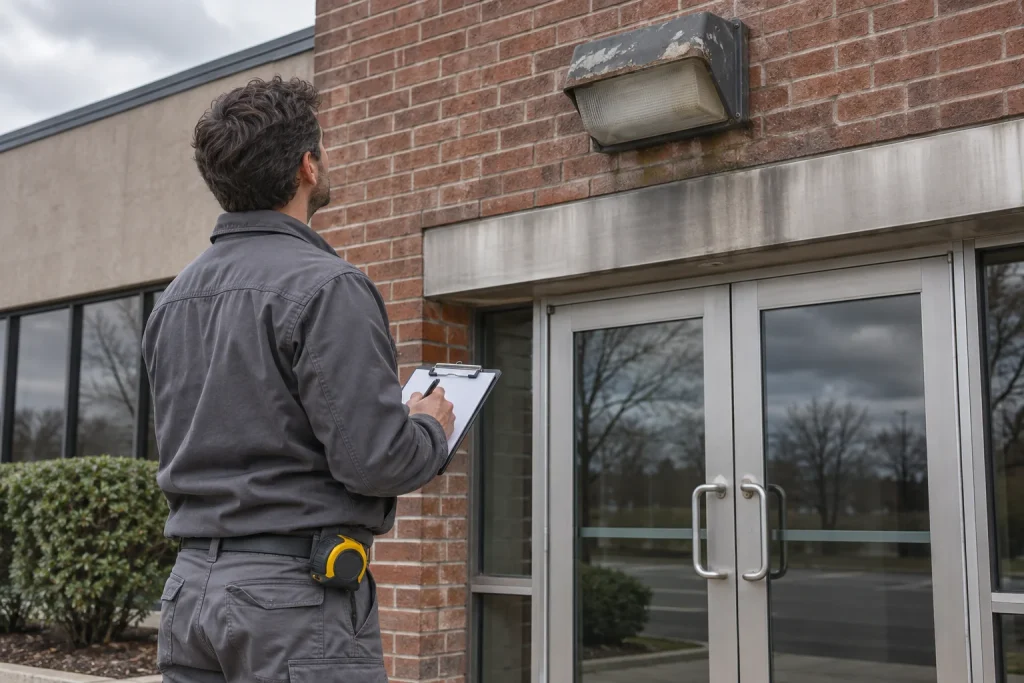
Use AI to assemble an estimate worksheet from job notes, photographs and an approved service catalog. Require it to label observations, customer statements, assumptions and missing information separately. A qualified estimator then confirms the scope, selects approved rates and terms, and decides whether the draft is suitable to send.
The useful output is an organized preparation packet. It should help the estimator see what remains uncertain before pricing a job. It should not infer hidden conditions from a photograph, invent measurements or turn an incomplete site description into a firm promise.
Define the estimate packet’s inputs
Choose one service type with a stable intake process. For example, a maintenance business might begin with routine replacement requests after a site visit. Give the AI access only to the relevant job record, authorized notes, appropriate images and current rate references. Keep unrelated customer history outside the packet.
Record who collected each observation and when. A customer saying “about six feet” and a technician measuring six feet are different evidence. A photograph may document appearance while leaving size, internal condition and access constraints unresolved. Preserve those limitations so the estimator can decide whether a visit or measurement is needed.
Microsoft’s Field Service documentation, checked November 6, 2026, illustrates the separation of work-order details such as service tasks, products, services and price-list references. That is a useful reminder to maintain structured job information. It does not establish that an AI-generated scope or duration is accurate for your business.
Use a fact sheet that makes gaps hard to miss
| Field | Acceptable content | Hold point |
|---|---|---|
| Requested outcome | Customer’s stated problem and desired result | Request unclear or outside service scope |
| Observed condition | Named observer, dated notes and image references | Conflicting descriptions or unreadable evidence |
| Quantity and dimensions | Recorded measurements with units and source | Estimated from an image or copied without units |
| Access and scheduling | Confirmed access restrictions and customer availability | Unconfirmed permissions or constraints affecting the work |
| Materials and labor basis | Estimator-selected items and approved rate version | Unmatched item, obsolete rate or unsupported duration |
| Exclusions and open questions | Specific uncertainties requiring review | Material uncertainty hidden inside a polished narrative |
Ask the AI to return an explicit unknown when no input supports a field. The extracted-field validation guide covers why a correctly formatted number can still be the wrong measurement or quantity.
Work through a hypothetical draft
Imagine a property-maintenance business preparing a simple replacement estimate. A technician’s notes identify one damaged fixture and confirm the matching replacement model. They record access during normal business hours. The notes do not confirm whether concealed connections require additional work.
The AI prepares the known facts and raises the concealed-condition question. It does not add a second component merely because similar jobs often need one. The estimator decides what inspection, exclusion or further information is appropriate before giving the customer a price.
For a separate fictional arithmetic check, suppose the estimator has selected two labor hours at an approved illustrative rate of $85, a $120 part and $20 of supplies. The worksheet shows $170 + $120 + $20 = $310 before any other applicable charges. The AI may check the addition. It has not established that two hours are sufficient, that those rates are commercially appropriate or that the scope is complete.
If a later measurement changes the part selection, invalidate the old draft. Keep the estimator’s selected scope and rate version connected to the calculation so the next reviewer can identify what changed.
Review scope before polishing the wording
Have the estimator first confirm the job location, customer request, evidence and service boundaries. Then check quantities, labor assumptions, materials, travel or access conditions and any exclusions. Finally review the customer-facing explanation. Good grammar cannot compensate for a missing site constraint.
Use the business’s approved terminology for the type of document being sent. The guide to explaining an estimate and a fixed-price quote helps organize customer expectations. Questions about the legal effect of terms belong with the business’s qualified adviser; the model should not decide that an estimate is legally binding or safely exempt from a requirement.
Keep specialist design, safety assessments and regulated trade decisions with the qualified people who perform them. This workflow organizes records; it supplies no diagnosis, code determination or authority to undertake work.
Make the release gate specific
The reviewer should approve the exact scope, pricing basis, assumptions, document version and recipient. Keep an internal worksheet and a customer draft as separate states. The AI preparing the packet should have no send, purchase or scheduling authority during the pilot.
If a customer requests a change after approval, return the affected fields to review. Do not reuse a prior approval simply because the customer’s name and job address match. Check that the sending system actually delivered the approved version rather than reporting success when only a draft was saved.
Evaluate preparation errors by cause
Compare a sample of AI-prepared packets with the original notes and the estimator’s final decisions. Count unsupported scope additions, missing conditions, wrong rate versions, unit mistakes and unresolved questions omitted from the customer draft. Label examples as pilot observations only after the business actually runs that comparison.
NIST’s Generative AI Profile recommends checking generated evidence and evaluating performance in context. For estimate preparation, that means measuring whether the worksheet preserves what the estimator needs to decide, with uncertainties visible. Faster drafting alone does not demonstrate a sound estimate.