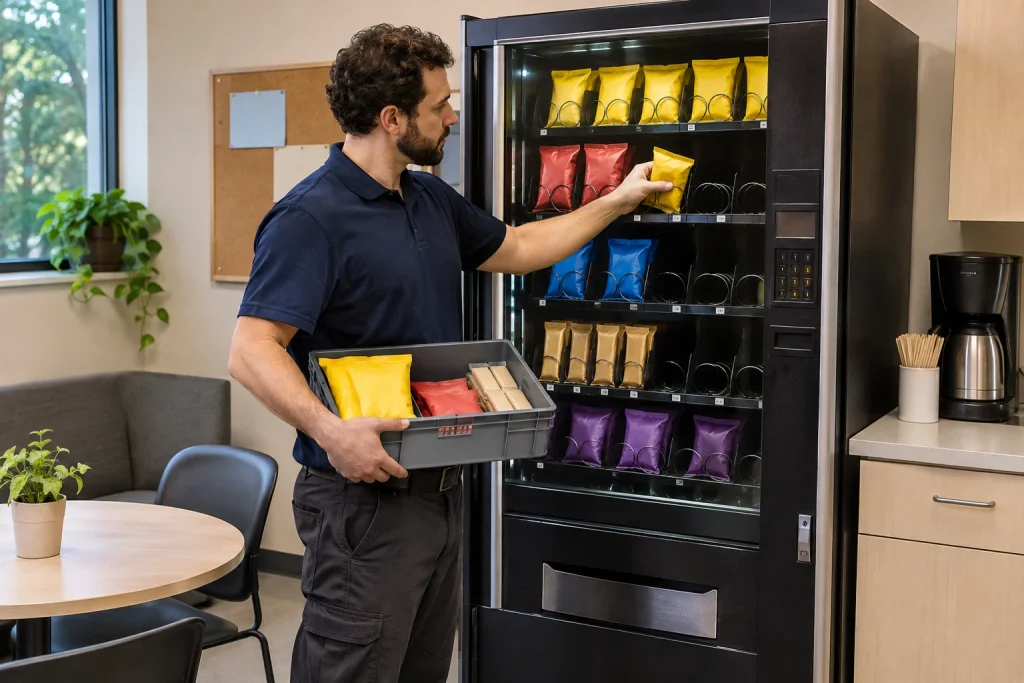
A vending route business depends on suitable locations, reliable equipment and product turnover that supports stocking and service costs. Start with the location and its operating agreement before counting machines. A machine placed in a poor or uncertain location creates equipment and inventory obligations without proving customer demand.
Assess the location as an operating relationship
Identify who may authorize placement, where the machine will sit and when the operator can access it. Ask about the people actually present, their schedules, competing food options and purchasing preferences. A large building does not necessarily contain a large daily buying audience.
Agree responsibilities for electricity, access, cleaning around the machine, damage reports and service requests. Clarify any commission, removal terms and ownership of the machine. Have appropriate advisers review commercial commitments rather than relying on an informal promise that the location will always be available.
- Documented permission from the authorized location owner.
- Suitable placement and customer access.
- Restocking and maintenance access windows.
- Product categories appropriate to the site.
- Payment-system and connectivity requirements.
- Refund, fault-reporting and removal arrangements.
Calculate at the product and machine level
Record selling price, product purchase cost, payment charges, location costs and expected spoilage or damage. Add travel, restocking labor, storage, equipment maintenance, insurance quotations and administration. Sales receipts are not owner earnings.
For a hypothetical example, assume a machine sells one hundred items during a review period. After product cost and direct transaction charges, an invented fifty cents per item remains before route labor, location charges, repairs and overhead. That is fifty dollars available toward those remaining costs. The example does not predict sales volume or establish a typical margin.
Track product turnover rather than filling every slot equally. Slow items tie up cash and may expire before sale. A busy item can require more frequent service. The useful mix depends on observed purchases at the location, not the supplier’s most attractive machine photograph.
Check food and labeling obligations
Michigan’s food licensing guidance distinguishes categories of vending and food operations within that state. FDA also provides vending-machine calorie-labeling guidance for covered operators. These sources show that the answer depends on the products, operation and applicable rules; they do not provide a universal vending clearance.
Contact the relevant local or state food authority with the actual product list, storage arrangements and machine type. Determine the applicable registration, food-safety, inspection and labeling requirements before launch. Refrigerated or prepared food raises different operating questions from packaged shelf-stable snacks.
Keep the machine and stock under an appropriate maintenance and food-handling process. Arrange training and manufacturer-supported service rather than improvising repairs. A payment reader that works during purchase does not establish that refrigeration, dispensing and refund arrangements are ready.
Validate records and service workload
If considering an existing route, request machine-level operating records, product purchases, payment reports, maintenance history and documented location arrangements. Reconcile claims with evidence and obtain qualified advice before a purchase. A seller’s revenue summary alone does not establish transferable location rights or future performance.
For a new location, use a small authorized pilot after required setup. Track sales by item, stockouts, spoilage, service visits, travel and refunds. In an illustrative office location, strong purchases on three occupied days may coexist with little activity on remote-work days. Restocking should reflect that pattern instead of assuming five identical weekdays.
Decide the review period and continuation criteria in advance. The machine should support its share of full route costs under observed demand, and the location relationship should remain workable. Relocation or withdrawal may be the right conclusion if the evidence does not support continued operation.
Grow route density and maintenance capability deliberately. More machines can create more travel, stock and fault calls without improving the model. A useful expansion decision rests on verified location arrangements and measured service economics, with no promise of passive income or guaranteed returns.
Inspect the equipment record as carefully as the sales record. Age, model, payment compatibility, service availability and known faults affect what the operator will inherit. Obtain a competent equipment assessment before a purchase where appropriate, and keep the cost of required changes distinct from the asking price.
Ask whether machine access remains practical during holidays, building closures and changes in occupancy. A location may be suitable for buyers but difficult for restocking. Document the agreed service arrangements and test them during the pilot, including the route a worker uses to bring stock to the machine.