Compare home-service business models on four things you can check before you spend money: what gates entry (who may legally do the work and how long qualification takes), whether demand repeats on a schedule or must be re-won with every job, how much you must own before the first paid job, and what role the owner plays in the work. Then test each candidate against your own cash and time, not against someone else’s story. This article ranks no trade by income, and nothing in it predicts earnings.
The four-dimension matrix
The “entry gate” column draws on the Bureau of Labor Statistics pages cited below. The other columns are this article’s illustrative judgments, meant to be checked against your own market, so treat them as a starting hypothesis and not as findings.
| Business model | Entry gate | Demand pattern | Asset intensity | Owner role |
|---|---|---|---|---|
| Electrical contracting | High: most states require a license after a long apprenticeship | Mixed: service calls and projects | Vehicle, tools, test equipment, stock | Often a working tradesperson, then supervisor |
| HVAC service and installation | Medium to high: EPA refrigerant certification for nearly all technicians; some states and localities license | Seasonal peaks, with maintenance plans as recurring demand | Vehicle, tools, equipment stock, gauges | Working technician early, manager later |
| Residential painting | Lower on training; EPA lead-related certification and state rules can apply, especially on older homes | Project-based, referral heavy | Tools, ladders, protection materials | Estimator and quality lead |
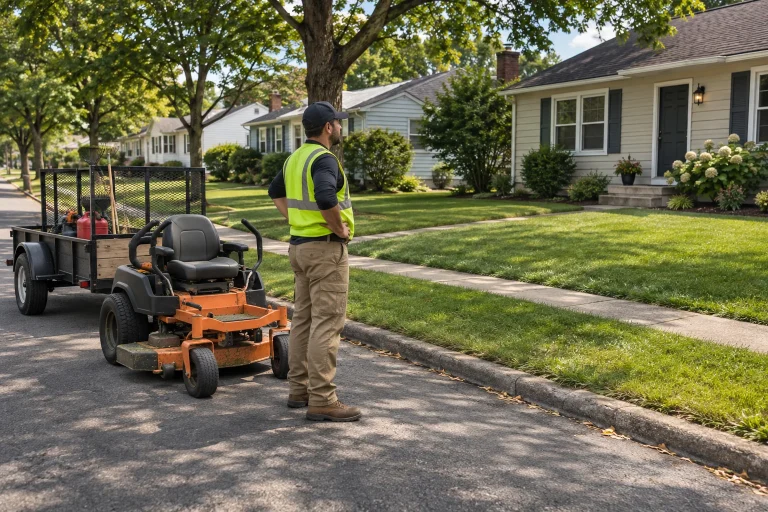
| Lawn and landscape maintenance | Low for basic mowing; licensing where pesticides are applied | Recurring routes | Trucks, trailers, mowers, handheld tools | Route manager; early on, crew member |
| Snow removal | Low on credentials; high on readiness | Event-driven and seasonal | High: plows, spreaders, standby | Dispatcher and risk manager |
The BLS says that for electricians most train in a four- or five-year apprenticeship and most states require a license. For HVAC, it says EPA requires nearly all technicians to be certified in refrigerant handling, and some states and localities require a license. For painters it says no formal education is required and most learn on the job. For grounds maintenance workers it notes entry-level jobs usually require no formal education and most states require a license to apply pesticides. Requirements for your state and city can differ, so confirm with the licensing agency.
Two numbers that beat a gut feeling
For each candidate, estimate (1) the cash you must spend before the first paid job and (2) the months until you can legally and competently do that first job. Then compare against what you have. Here is a hypothetical owner with $30,000 in savings and monthly personal and business burn of $3,200.
- Runway: $30,000 ÷ $3,200 = 9.4 months of burn if no income arrived at all.
- Candidate A, a route business: $20,000 in equipment, first paid job in month 3. Cash needed before income: $20,000 + 3 × $3,200 = $29,600.
- Candidate B, a licensed trade: assume 14 months of qualification and licensing work before the first paid job as an independent business, with $3,200 a month burn: 14 × $3,200 = $44,800, plus any equipment.
Candidate B fails the cash test outright ($44,800 against $30,000) unless the owner works for an established firm during qualification and keeps income. Candidate A passes by a hair: $30,000 − $29,600 = $400. For this hypothetical stress test, applying a 10% reserve to the $29,600 gives $32,560, more than the owner has. So A also fails as a plan unless the equipment is financed in part, leased, bought used after a test month, or phased. The 10% is for illustration only; choose a reserve that fits how unpredictable your costs are. The point is that the check forces the real question: what would have to change for the plan to work?
Score owner fit separately
Add three questions the matrix cannot answer for you.
- Will you do the work or manage it? Many tradespeople love the work and dislike dispatch, estimating and collections. Many managers are fine with spreadsheets and miserable in a truck. Pick a model that matches your strongest daily task for the first year.
- How do you handle seasonality? Event-driven and seasonal businesses have long idle stretches and short intense ones. Check your own tolerance for each, and whether another line can fill the slow months.
- Who is your first customer? Recurring routes depend on route density. Project businesses depend on referrals and estimating. Neither can be tested only by reading.
Use the comparison to design a test, not a launch
Before you commit to a model, set a cheap test with a stop rule. For a route business, you might secure eight recurring customers on a compact route before buying a second vehicle. For a licensed trade, you might spend a year as an employee and write down what you learn about the field’s paperwork and customers. A test that costs 10% of the full plan and answers one question beats a full launch that answers all of them too late.
Check the numbers with the right people
Ask the licensing agency what it requires, an insurance professional what coverage the work implies, and a bookkeeper or accountant how the business should be set up. If you speak with someone already in the trade, ask for the unglamorous details: how long first payment takes, what a normal callback costs, which tools are used weekly and which are idle.
Failure cases
- Choosing the business with the lowest entry gate, then discovering the demand pattern does not fit your cash.
- Choosing by income stories, which describe survivors and tell you nothing about your market.
- Ignoring the owner-role question and ending up in a job you dislike.
Owner action
Pick your top two candidates. Fill in the matrix with local facts, compute the two cash and time numbers, and write the stop rule for a small test. Share the page with someone who has run a similar business and ask them where it is wrong.
Sources
- U.S. Bureau of Labor Statistics: Electricians (apprenticeship and state licensing).
- U.S. Bureau of Labor Statistics: Heating, Air Conditioning, and Refrigeration Mechanics and Installers (EPA certification and licensing).
- U.S. Bureau of Labor Statistics: Painters, Construction and Maintenance (training and lead certification).
- U.S. Bureau of Labor Statistics: Grounds Maintenance Workers (entry requirements and pesticide licensing).