A laundry pickup and delivery business needs a reliable chain from collection to processing and return. Decide whether you will operate the laundry facility or coordinate with a processing partner, then define who is responsible for each stage. A convenient booking page cannot compensate for mixed orders or an unsupported return promise.
Start with a clearly described garment category and service area. Ordinary washable household laundry differs from dry cleaning, specialty garments, commercial linens, or contaminated textiles. Accept only items your processing arrangement is equipped and authorized to handle.
Choose the processing model first
If you process laundry yourself, assess premises, suitable equipment, utilities, capacity, maintenance, and local requirements. If a partner processes it, verify the actual service, turnaround, accepted items, handling process, and resolution of missing or damaged items. Define the relationship before advertising the partner’s capability as your own.
Tide Laundromat’s published pickup service illustrates the distinct stages customers experience: scheduling, collection, cleaning, and return. Your service needs its own operating details and availability; another provider’s public process is not evidence of what you can deliver.
Define what customers may send
Publish a clear accepted-items list and exclusions based on competent processing guidance. Ask for relevant preferences and identify how items needing special attention are handled. Do not promise stain removal, disinfection, or protection against every kind of damage.
The FTC’s care-label guidance explains the information manufacturers and importers provide about garment care. For a laundry service, care instructions are an important input to competent processing. This does not mean a general pickup business can interpret every textile or override a label at the customer’s casual request.
Give every order an identity
| Stage | Record to preserve |
|---|---|
| Booking | Customer, service requested, pickup and return arrangement |
| Collection | Order identifier, bag count, and agreed condition observations |
| Processor handover | What was transferred, when, and to whom |
| Processing complete | Completed order and any exception requiring review |
| Return | Recipient or authorized placement and completion evidence |
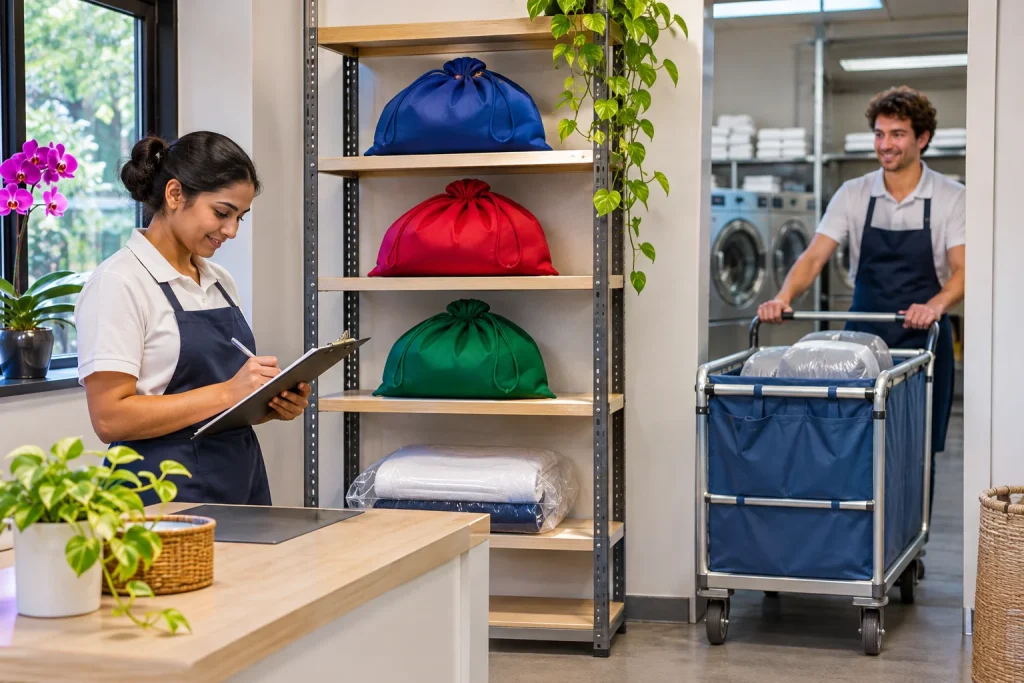
Choose a tagging and separation method that fits the processing operation. A handwritten name on one loose bag may not survive a busy transfer. Test identification through the complete cycle rather than only at the first pickup.
Calculate the two-way route
Include collection and delivery, waiting, loading, processing charges or internal processing costs, packaging, customer communication, and exception handling. If you charge by weight or another measure, define when and how the measure is established through the appropriate process.
In a hypothetical neighborhood route, ten customers each require one pickup and one return. That creates twenty customer stops, even if processing occurs in one batch. A price built around ten stops overlooks half the customer-facing travel. These are illustrative order counts, not a forecast of route profitability.
Promise a return window you can support
Confirm processor capacity and collection cutoffs before committing to turnaround. Plan for unsuitable items, equipment downtime, weather, customer absence, and delayed handovers. State which conditions require a revised return arrangement and who communicates it.
Offer expedited service only when the entire chain supports it. A fast pickup does not establish that the processor can complete the work sooner. Keep any change in service or charge clear before proceeding.
Handle exceptions while the order is identifiable
Decide what happens when a customer reports a missing item, a preference was not followed, or the processor identifies an unsuitable garment. Keep the original order record and communicate the known facts. Do not guess which customer owns an untagged item.
Use a written process for complaints and have appropriate professional help with service terms and coverage. Protect customer addresses, access instructions, and garment photographs. Do not leave returned laundry at an unapproved or unsuitable location just to close the route.
Assess minimum order size against the cost of both customer stops and processing. A dense route can still be uneconomic if most orders are too small to cover handling. Explain any minimum charge before collection and review exceptions from actual route records rather than assuming every extra bag improves the business.
Validate the chain before expansion
Check official local business, premises, wastewater, transport, and laundry-related requirements for the model you choose. Requirements differ between operating a facility and arranging pickup for an established processor. Discuss the actual handling and customer-property risks with an insurance professional.
Pilot a small area and track total route time, processing accuracy, turnaround, order identification, and repeat corrections. Expand only when you can trace each order and the full round trip contributes enough to support the business.