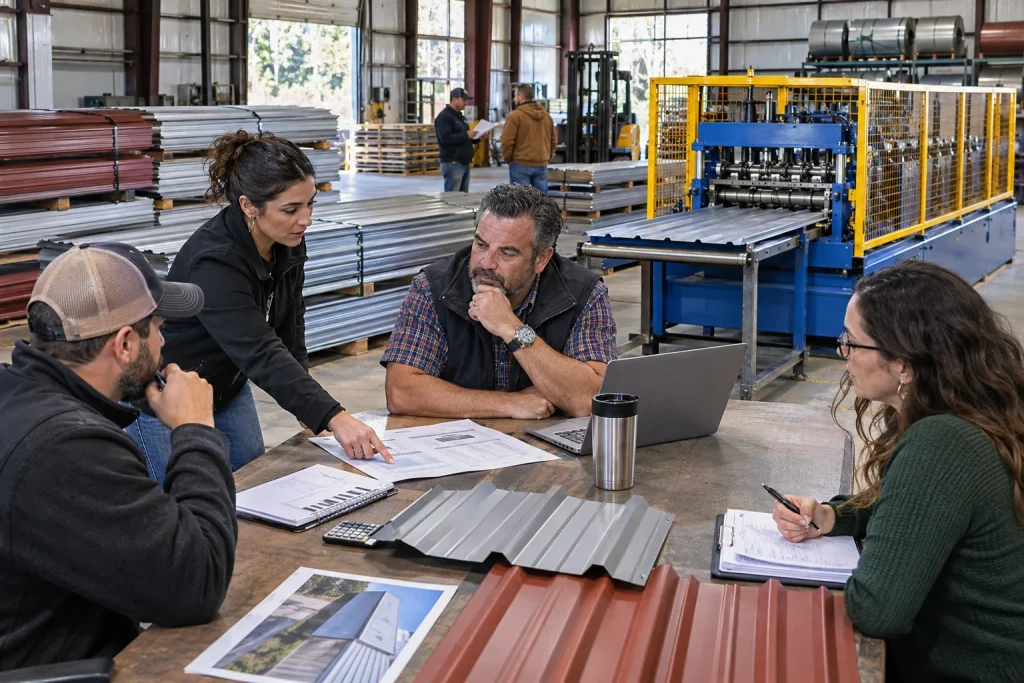
Buy supplier-made metal panels until your annual job volume clearly exceeds the break-even number for owning a roll former, and until you have a trained operator, a safety program for the machine, a coil plan and a written answer on warranty acceptance. Owning a roll former can give you control over lengths and lead time. It also turns a contractor into a small manufacturer. This article covers the economics and responsibilities, not how to run the machine; follow the manufacturer’s instructions and applicable safety rules for that.
The cost of ownership, per year
Use a hypothetical purchase: roll former $45,000 plus trailer, power and handling equipment $12,000, so $57,000 in total. Assume four years of use and a $24,000 resale value. Annual cost:
- Depreciation: (57,000 – 24,000) / 4 = $8,250
- Financing: $2,400
- Insurance, storage and maintenance: $3,350
Fixed ownership cost = 8,250 + 2,400 + 3,350 = $14,000 a year, whether you form panels for 5 jobs or 50.
The saving per job
Compare the supplier-made panel package with your own for the same job:
| Item | Buy supplier panels | Roll form yourself |
|---|---|---|
| Panels, delivered, or coil purchased | $6,800 | $5,150 |
| Consumables, fuel and wear | Included | $210 |
| Forming labor, 2 operator-days at $400 | None | $800 |
| Transport and handling of coil and panels | Included | $140 |
| Cost per job | $6,800 | $6,300 |
Own-forming cost: 5,150 + 210 + 800 + 140 = 6,300. Net saving per job = 6,800 – 6,300 = $500.
Break-even jobs
Break-even = fixed annual cost / saving per job = 14,000 / 500 = 28 jobs a year. At 12 jobs, the machine loses 14,000 – (12 x 500) = $8,000 a year. At 40 jobs, it gains (40 x 500) – 14,000 = $6,000. The sensitivity is large: a $100 change in saving per job moves break-even from 28 to 35 jobs (14,000 / 400), or to 23.3 jobs (14,000 / 600). Test your saving figure against actual supplier quotes, not a list price.
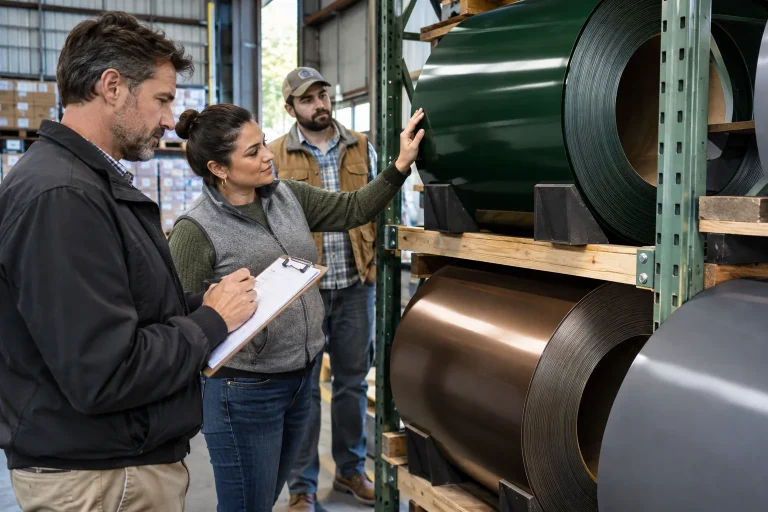
Now add inventory. Suppose you hold coil in 6 positions (three colors, two gauges), averaging $3,500 on hand each. That is 6 x 3,500 = $21,000 of coil. At a carrying cost of 1.5 percent a month, that is 21,000 x 0.015 = $315 a month, or $3,780 a year. Fixed cost rises to 14,000 + 3,780 = $17,780, and break-even becomes 17,780 / 500 = 35.6 jobs. Each color and gauge you offer carries stock, so the offer is a cost driver.
The responsibilities that are not in the spreadsheet
- Safety. OSHA’s machine guarding page says any machine part, function or process that may cause injury must be safeguarded, and lists crushed fingers or hands, amputations, burns and blindness among the possible results of moving parts. OSHA’s lockout/tagout page says unexpected startup or release of stored energy during servicing can cause serious injury or death, and that employers must train workers in the energy control procedures. That page cites the general-industry standard, so ask OSHA, or its free consultation program, which standards apply where and how you will use the machine.
- Trained operators. Name two people who can run it, one primary and one backup. If you have one operator and that person is out, you are back to buying panels, so keep the supplier relationship active.
- Quality control. Panels you form are your product. The Metal Construction Association’s roofing certification is a program companies enroll in; it is aimed at paint and product manufacturers, coil processors and roll formers, including roll formers with a mobile machine. It involves a quality control table signed by a third-party auditor (or, for some eligible companies, a corporate officer) and a sample material test report for each product. The page does not present enrollment as a legal requirement, but it shows the kind of record-keeping a manufacturer is expected to have.
- Warranty acceptance. Ask your coil supplier in writing whether its finish, substrate or weathertight warranties apply when the panels are formed by a contractor, and under what conditions. Do not assume.
- Transport and site logistics. Long panels need planning from the shop or site to the roof.
A decision rule
- Count signed or documented jobs per year that use a standard profile you can form.
- Compare to break-even, including coil inventory. Require at least 25 percent above break-even in committed volume, so with 35.6 break-even jobs, look for about 45.
- Confirm operator, safety program, supplier warranty acceptance and coil terms in writing.
- If any item is missing, buy panels for another quarter and revisit.
The right answer for many small crews is to buy panels and let the supplier carry the machine and the inventory. Ownership makes sense when volume is steady and your control of length and lead time earns more than the machine costs.
Sources
Pages below were read on November 12, 2026. Rules, programs and warranty terms change, so confirm current details with the named agency or document before relying on them.
- OSHA: Machine Guarding overview. Supports the statement that machine parts, functions or processes that may cause injury must be safeguarded and that moving parts can cause serious injuries including amputations.
- OSHA: Control of Hazardous Energy (Lockout/Tagout) overview. Supports the statements that unexpected startup or release of stored energy during servicing can cause serious injury or death and that employers must train workers on energy control procedures. The page cites 29 CFR 1910.147 for general industry.
- Metal Construction Association: Roofing Certification. Supports the description of the MCA certification program that companies enroll in (paint and product manufacturers, coil processors and roll formers, including mobile roll formers), based on a signed quality control table and a material test report for each product.