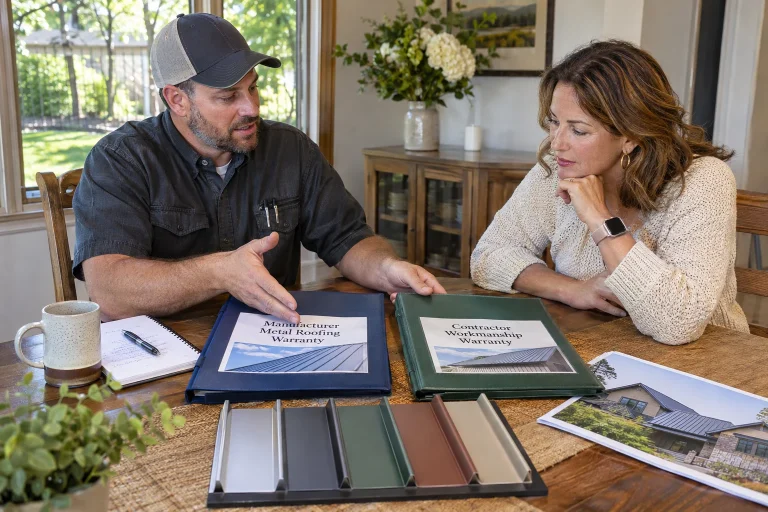
Track roofing callbacks in a log that classifies each one, records who is responsible for what, and counts the time and money it consumes, so you can see the real cost per completed job instead of hiding it under “customer service.” A callback is any contact after closeout that sends someone back or occupies staff time. The classification is an operational routing decision. It is not a legal admission, and it does not replace the written terms of your contract or warranty documents, which come from your attorney and the manufacturers.
Four categories, one rule
| Category | What it means | Who acts |
|---|---|---|
| Workmanship inquiry | The customer reports a condition that may relate to work your crew performed. It stays an inquiry until someone inspects it. | Your company |
| Material or manufacturer routing | The reported condition may fall under a manufacturer’s or supplier’s warranty on a product or finish. | Manufacturer or supplier, with your help preparing the claim |
| Unrelated issue | After inspection, the condition is outside the scope of what you did. | Customer or another provider |
| Owner maintenance | The condition relates to upkeep the customer or manufacturer documents assign to the owner. | Customer |
The rule: classify twice. Record an initial category when the call arrives, and a verified category after inspection. Never delete the first. The difference between them shows how well your intake process screens issues and how often a first impression is wrong.
Why the split matters
Responsibility is divided in real documents. The FTC’s business guide to federal warranty law says the law covers warranties on consumer products, including property attached to or installed on real property. It says warranties on services are generally not covered, but that the law can apply when a warranty covers both parts and workmanship, and that written warranty terms must appear in a single clear document. Whether and how that applies to your paperwork is a question for your attorney. What it shows for your log is that material coverage and workmanship coverage are different things and should be recorded separately.
Manufacturer terms also carry timing conditions. One supplier’s published explanation of its paint warranty describes a claim submitted in writing within a stated period after the owner becomes aware of the condition, an opportunity for the manufacturer to inspect, and maintenance conditions. Another example, a supplier’s weathertight warranty page, describes a program with certified contractors and project inspection. These are examples from particular documents, not terms you can assume for your product. They are the reason your log must record the date the customer first reported the condition and must route possible material claims to the right party promptly. A late notice can cost the customer coverage.
The log fields
- Job ID, completion date and the documents delivered at closeout
- Date and channel of first report, in the customer’s own words
- Initial category and verified category, with the date of inspection
- Responsible party and the next action with an owner and due date
- Time spent: crew hours, office hours, vehicle trip, materials
- Resolution date and what the customer was told
- Cause code, so you can find patterns in sales, estimating, supply or installation
A worked quarter (hypothetical)
In one quarter you complete 40 jobs and log 9 callbacks.
| Verified category | Count | Average cost each | Total |
|---|---|---|---|
| Workmanship inquiry | 3 | $540 | $1,620 |
| Material or manufacturer routing | 2 | $110 | $220 |
| Unrelated issue | 3 | $85 | $255 |
| Owner maintenance | 1 | $85 | $85 |
| Total | 9 | $2,180 |
Total cost: 1,620 + 220 + 255 + 85 = $2,180. Callback rate of any kind: 9 / 40 = 22.5 percent. Workmanship inquiry rate: 3 / 40 = 7.5 percent. Cost per completed job: 2,180 / 40 = $54.50.
Several findings follow. First, the three unrelated issues and the maintenance case cost $340 of staff time even though you were not responsible; that is a signal to improve what you tell customers at closeout. Second, workmanship inquiries are rare but expensive, so each one deserves a cause code. Third, material routing cases are cheap for you but high-stakes for the customer; speed matters.
Rules that keep the log honest
- Do not reclassify to improve a number. If an inquiry becomes a workmanship issue, it stays one.
- Count unrelated calls. They consume time and reveal confusion.
- Separate the person who classifies from the person whose crew did the work where possible.
- Review monthly. Look at cause codes and what you will change in estimating, supply or training.
- Tell the customer the next step the same day, including who will inspect and when.
Written warranty and liability terms belong with your attorney. The log is an operational tool, not a legal document.
Sources
Pages below were read on November 12, 2026. Rules, programs and warranty terms change, so confirm current details with the named agency or document before relying on them.
- Federal Trade Commission: Businessperson’s Guide to Federal Warranty Law. Supports the statements that the federal warranty law covers consumer products including property installed on real property, that warranties on services are generally not covered but a warranty covering both parts and workmanship can be, and that written warranties must be in a clear document.
- Sheffield Metals: Metal Roof Paint Warranties in Simple Terms. Used as one example of a finish warranty: claims are submitted in writing within a stated period after the customer becomes aware, the manufacturer must be allowed to inspect, and maintenance conditions apply.
- Sheffield Metals: Weathertight Warranties. Used as one example of a supplier weathertight program that involves certified contractors and project inspection, showing why workmanship and material responsibilities are separate.