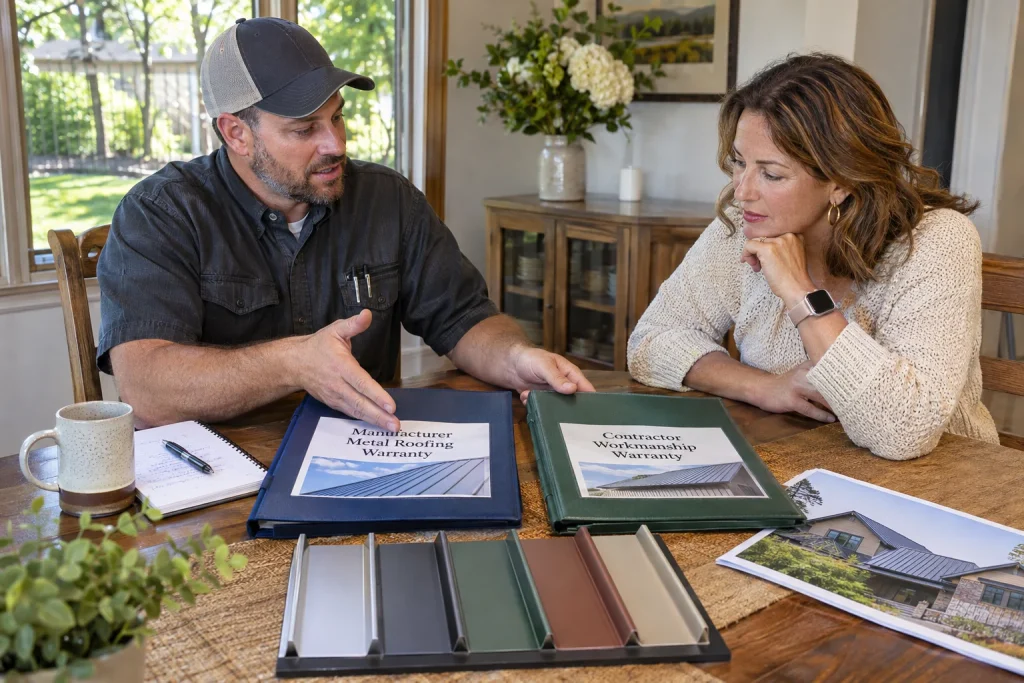
Explain metal roofing warranties by naming each document, who issued it and what it covers, handing over the real documents, and keeping your own workmanship terms separate from the manufacturer’s material and finish terms. A customer who hears “it has a warranty” may assume one promise from one party. In practice they may hold several documents from different issuers, each with its own conditions. This article is a communication plan. It does not state any coverage period, because those belong to the actual documents, and it does not draft warranty or legal language, which should come from the issuer and your attorney.
A responsibility matrix
| Document or promise | Typically issued by | What to confirm before you describe it |
|---|---|---|
| Finish (paint) warranty | Coating, coil or panel supplier | Which coating and product it covers; what it says about adhesion, chalking and fading; conditions and exclusions |
| Substrate warranty | Metal or coil supplier | Which metal it covers and whether corrosion of the base metal is in scope |
| Weathertight or system warranty | A supplier or manufacturer program | Whether your project qualifies, which installation details and inspection steps are required, and who applies |
| Contractor workmanship terms | Your company | Exactly what your signed contract says, drafted with your attorney |
The point of the matrix is to prevent one phrase from covering four things. A finish warranty and a substrate warranty are separate on the example explained in a supplier’s article on paint warranties: the paint warranty covers the paint applied over the metal, and corrosion of the metal beneath falls under a separate substrate warranty. A weathertight warranty program from the same supplier is described as involving certified contractors, specified installation details, application materials such as roof plans and project inspection, which is a different kind of commitment entirely.
What each document may condition
Read the documents for your product and make a one-page summary the customer can take away, quoting the source and page. The example paint warranty page lists conditions of the kind you should look for in any document, though your product’s terms may differ:
- Separate time limits for different issues, such as adhesion versus chalking and fading.
- Exclusions, such as certain weather events, wind uplift damage, improper handling during installation, exposure to corrosive substances and dissimilar-metal corrosion.
- Installation conditions, including that non-standard installation details can void coverage, and conditions for accessories that attach through the roof, such as solar equipment or snow guards, which the example says should be discussed with the manufacturer and contractor first.
- Maintenance conditions, such as printed guidelines and, in the coastal example, a regular rinse with records kept.
- Claims process, such as written notice within a stated period (30 days in that one example) after the owner becomes aware of a condition, a chance for the manufacturer to inspect, and returning the signed warranty to the issuer.
These are examples from one supplier’s documents. Do not assume your product shares them.
Where federal warranty law fits, and where it does not
The FTC’s business guide to federal warranty law says the law covers warranties on consumer products, including property attached to or installed on real property. It says warranties on services are generally not covered, but that the law can apply when a warranty covers both parts and workmanship. It also says written warranty terms must be presented in a single, clear and easy-to-read document. Whether your documents fall under it, and how to label them, is a question for your attorney. The practical lesson for your handoff is to avoid blending a manufacturer’s material terms and your service terms into one vague promise.
The handoff routine
- Before the sale closes: give the customer the actual finish and substrate warranty forms for the product proposed, and note any program your project may or may not qualify for.
- Before ordering: confirm what the supplier needs from you to issue each document and who submits it.
- At closeout: deliver the issued documents, the registration confirmation, the maintenance requirements and your own written terms, each labeled with the issuer.
- Afterward: record the date and method of delivery, and file copies.
A sample customer conversation (hypothetical)
A customer asks, “Is my roof covered for decades?” A clear answer has the shape: “There are separate documents. The finish warranty from the supplier covers the paint on the panels; here is the document and the sections on what it covers, what it excludes and what maintenance it requires. The substrate warranty covers the metal itself under a separate form. Our own terms, which cover our installation work, are in your contract on page X. If you notice a problem, tell us the same day, and we’ll help you contact the right party, because some claims have notice deadlines.” That answer names no years because the years belong to the documents.
Failure cases
- Quoting a number of years from memory or from a brochure for a different product.
- Promising that a weathertight program applies before your project has been approved for it.
- Installing accessories that a warranty says need approval, without checking.
- Failing to return a signed warranty or register where required, which can leave the customer without the coverage you described.
Sources
Pages below were read on November 12, 2026. Rules, programs and warranty terms change, so confirm current details with the named agency or document before relying on them.
- Sheffield Metals: Metal Roof Paint Warranties in Simple Terms. Supports the descriptions of a paint (finish) warranty versus a separate substrate warranty, example exclusions, maintenance conditions, written notice within a stated period (30 days in the example), and the need to return the signed warranty to the issuer. All items are from one example, not general terms.
- Sheffield Metals: Weathertight Warranties. Supports the example that one supplier’s weathertight warranty program involves certified contractors, installation details, application materials and project inspection.
- Federal Trade Commission: Businessperson’s Guide to Federal Warranty Law. Supports the statements that the federal warranty law applies to consumer products including property installed on real property, that warranties on services are generally not covered but combined parts-and-workmanship warranties can be, and that written terms must be clear and in a single document.