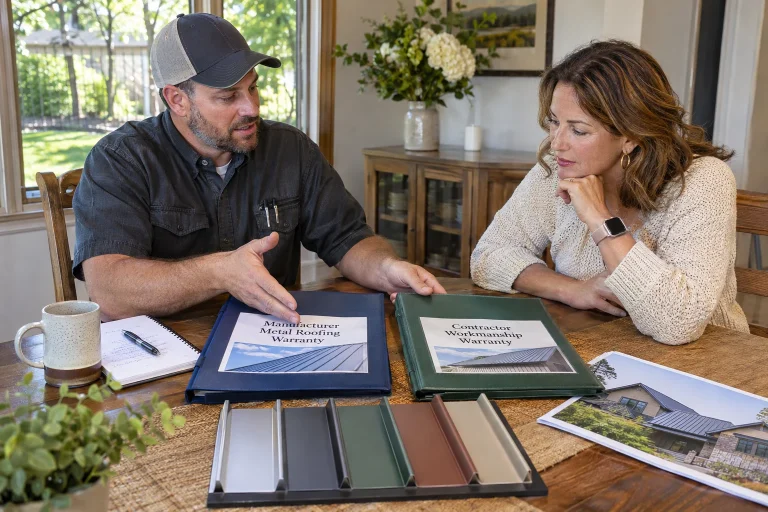
Sell a metal roofing specialty by describing what your company can show, such as the systems you install, the training behind them, the documents the customer receives and the limits of each, and by keeping a claims register so no promise appears in your marketing without evidence. Metal roofing invites big words: lifetime, maintenance-free, energy-saving, storm-proof. Each can be misleading in context, and each can contradict the warranty document you hand over. The FTC’s small-business advertising guide says advertisers need a reasonable basis, meaning objective evidence, for claims before the ad runs.
Build the offer from capabilities
A capability-based offer is a short statement that a stranger could check. Template: “We install [system class] from [supplier or manufacturer] on [building types] in [area]. Before you sign, you receive [documents]. We do not [excluded work].” Each blank should be filled with something you can support, such as a training record, a supplier relationship, a sample document or a completed project you have permission to show. If you cannot fill a blank honestly, narrow the offer.
The claims register
Keep a single table that governs every claim on your website, brochure, truck and proposal.
| Claim | Evidence required | Approved wording | Owner |
|---|---|---|---|
| We specialize in [system] | Training record, supplier relationship, completed jobs | “We install [system] from [supplier].” | Owner |
| Warranty coverage | The actual document for the product proposed | “The manufacturer’s [name] warranty is provided before you sign; it covers [per the document].” | Office lead |
| Durability or lifespan | Documented, product-specific evidence you can produce | Quote the document; avoid “lifetime” | Owner |
| Energy or cost savings | Evidence for the specific product and conditions | Do not state a figure you cannot support for this customer | Owner |
| Storm performance | Specific test or product documentation | Describe what the document says, with limits | Owner |
| Customer testimonials | Permission, accuracy and a typical-experience check | Quote exactly; identify unusual results | Marketing lead |
Why blanket claims fail
The FTC guide says disclosures must be clear and conspicuous and that fine print cannot be used to contradict other statements in an ad. It also says endorsements must reflect the honest experience of the endorser, and that for consumer endorsements the ad must reflect the typical experience; “your results may vary” is not enough. Compare that with a real document. The example paint warranty explained on one supplier’s page excludes certain weather events, wind uplift damage and damage from improper handling, and it carries maintenance conditions. A sales line saying “storm-proof” or “covered for life” would contradict that kind of document, even if the paper existed. Describe the coverage the document gives and name its limits, and your sales story stays consistent with what the customer later holds.
Rewrite three claims (illustrative examples)
- Before: “Our metal roofs last a lifetime.” After: “We install [system]. The manufacturer’s finish and substrate warranties for that product are available before you sign, and we explain what each covers and what it requires from you.”
- Before: “A metal roof will cut your energy bill.” After: “Energy results depend on the building and the product. If it matters to your decision, we’ll point you to the manufacturer’s documentation for the product we propose and discuss what it does and does not show.”
- Before: “Storm-proof.” After: “We can show you what the product’s documents say about wind and impact, and what its warranty excludes.”
Set appearance expectations too
A metal-roof quote guide lists qualifications that appear in real quotes, such as “Pricing subject to change,” “Oil canning is not a cause for rejection” and “Valid for 30 days.” Whatever your supplier or manufacturer says about visible appearance, understand it before you sell, and say it to the customer in plain words before they sign. Appearance disputes grow from silence at the sale.
A system-fit check
| Customer situation | Response |
|---|---|
| Customer wants a system you do not install | Say so and refer or decline; do not stretch. |
| Building type or roof shape outside your experience | Name the limit; offer an inspection only if you can serve it. |
| Customer wants a result you cannot support | Replace the promise with the document and its limits. |
| Customer compares your price with a different system | Put the proposals side by side line by line and explain differences. |
Keep it honest after the sale
- Review the register every quarter, and whenever a manufacturer changes a document.
- Check each new ad, page and proposal against it before it goes out.
- Keep a dated copy of the evidence behind each claim.
- When the register says no, change the copy, not the evidence.
This is not legal advice. Have your attorney review advertising and contract language, particularly for any claim about performance, savings or coverage.
Sources
Pages below were read on November 12, 2026. Rules, programs and warranty terms change, so confirm current details with the named agency or document before relying on them.
- Federal Trade Commission: Advertising FAQ’s, A Guide for Small Business. Supports the statements that advertisers need a reasonable basis (objective evidence) before a claim runs, that disclosures must be clear and conspicuous and cannot be contradicted by fine print, and that testimonials must reflect typical experience and “your results may vary” is not enough.
- Sheffield Metals: Metal Roof Paint Warranties in Simple Terms. Used as one example of finish warranty exclusions and conditions (certain weather events, wind uplift damage, handling and maintenance conditions), showing why blanket claims can conflict with real documents.
- Sheffield Metals: How to Compare Quotes When Buying a Metal Roof. Used as an example of qualifications that appear in metal roof quotes, including “Pricing subject to change,” “Oil canning is not a cause for rejection” and “Valid for 30 days.”